pythondemos/unsupervisedlearning.pyDictionary of Applied Machine Learning
Updated on 2026-09-20
Typeset PDF version — the authoritative form of this entry
Python demo — a script that recomputes what this entry states and prints one line per check
Unsupervised learning is the machine learning (ML) setting in which the data points of a dataset carry features but no label, so nothing says what a correct answer for a data point would be. What is sought instead is structure: clustering collects similar data points into clusters, dimensionality reduction replaces many features by few, and density estimation fits a probabilistic model to the feature vectors. The price of the missing labels is the missing criterion. A validation error tells a supervised learning method when a hypothesis is worse, while the clustering error keeps falling as clusters are added and so cannot say how many there should be. Judging an unsupervised result needs something outside it, such as a downstream learning task or a person inspecting the clusters. Self-supervised learning and semi-supervised learning (SSL) are the other two answers to the cost of labels, differing in what they do with the same unlabeled data points.
The same weather station at Krems records eight measurements for each day of 2024: three temperatures, precipitation, sunshine duration, humidity, air pressure and wind speed. Nothing in the record says which of them is to be predicted from the others, and no quantity outside the record is attached to a day. What can still be asked of these days is how they arrange themselves: which of them resemble each other, how many of the eight numbers are needed to tell them apart, and which combinations of values are common. Unsupervised learning is the machine learning (ML) setting in which the data points of a dataset carry features but no label, and what is sought is structure among them (Hastie et al., 2009, Sect. 14.1; Sutton and Barto, 2018, Sect. 1.1).
Formally, the input is a dataset $\dataset = \big\{ \featurevec^{(1)}, \ldots, \featurevec^{(\samplesize)} \big\}$ of feature vectors $\featurevec^{(\sampleidx)} \in \featurespace$, with no label space in sight. In supervised learning the label of a data point says what the correct answer would have been, and here nothing does, which is why the two settings are called learning with and without a teacher (Hastie et al., 2009, Sect. 14.1). Three learning tasks make up most of the setting, and the days at Krems carry all three.
B-nocriterionClustering partitions the data points into
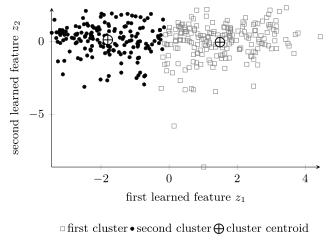
clusters of similar ones. $k$-means with $\nrcluster = 2$ clusters, applied to the
eight measurements after each is
scaled to zero sample mean and unit sample variance,
reaches a fixed point after ten iterations. Its two
clusters agree with the cold and the warm half of the year
on $90\%$ of the days (see
Fig. 1), although no month,
season or other label entered the computation.
Dimensionality reduction replaces the eight features by fewer:
principal component analysis (PCA) delivers two, which carry $64\%$ of the total
variance and leave a reconstruction error equal to the number
of data points times the sum of the dropped eigenvalues
of the sample covariance matrix. Density estimation fits a
probabilistic model to the feature vectors: a normal distribution fitted
to the temperatures of the first $244$ days assigns the remaining
days an average log-density of $-6.45$, against $-7.19$ for one
that keeps the same means but a diagonal covariance matrix.
pythondemos/unsupervisedlearning.py
Unsupervised learning is one of three answers to the cost of labels, and the three differ in what they do with the unlabeled data points. It uses them on their own and gives up the label entirely. Self-supervised learning constructs labels from the data points themselves by withholding some of their features, which turns the same raw collection into an ordinary supervised learning problem. Semi-supervised learning (SSL) keeps a few labeled data points and uses the unlabeled ones to support them. The boundary is a matter of where the label comes from, not of the data: one unlabeled dataset serves all three.
See also: clustering, $k$-means, dimensionality reduction, principal component analysis, probabilistic model, label, dataset, supervised learning, self-supervised learning, semi-supervised learning, clustering error, validation error.
@misc{dictml_unsupervisedlearning,
  author = {Jung, Alexander and Olioumtsevits, Konstantina and Schnoor, Ekkehard},
  title = {unsupervised learning},
  howpublished = {Dictionary of Applied Machine Learning (course edition)},
  year = {2026},
  doi = {10.5281/zenodo.21569296},
  note = {ISBN 978-952-64-3013-3, CC BY 4.0, retrieved 2026-09-21},
  url = {https://dictionaryofml.org/terms/unsupervisedlearning.html}
}