
kmeans.py, which recomputes what the entry states: the script block by block · open in ColabDictionary of Applied Machine Learning: 107 machine-learning terms, each with a definition, a figure, citations and a Python demo · All terms · Demos · Start here
Updated on 2026-10-22
Readiness 100/100
See also clustering empirical risk minimization hypothesis space Gaussian mixture model expectation–maximization
$k$-means is a hard clustering method for data points with numeric feature vectors. Each data point is assigned to exactly one of $\nrcluster$ clusters, each represented by a cluster centroid, namely the cluster whose cluster centroid is nearest in Euclidean distance. The cluster centroids are chosen to minimize the clustering error, the average squared Euclidean distance between a data point and its nearest cluster centroid. The resulting $k$-means optimization problem is an instance of empirical risk minimization (ERM) using a specific choice for the loss function. This optimization problem is non-convex and NP-hard, and typically solved using Lloyd's algorithm. This algorithm consists of a fixed-point iteration that never increases the clustering error and reaches a fixed point after finitely many iterations. Replacing the squared Euclidean distance by the Euclidean distance itself gives $k$-medians, whose averaging step computes a geometric median (GM) and which is less sensitive to outliers.
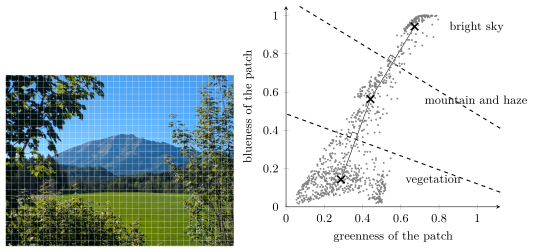
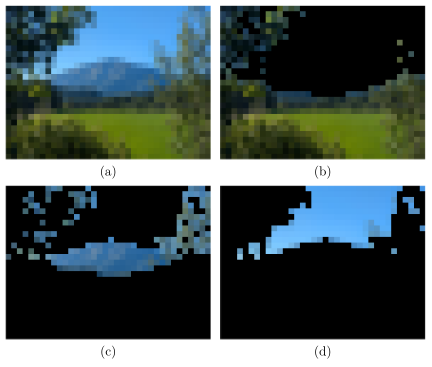
kmeans.py, which recomputes what the entry states: the script block by block · open in ColabB-patchesFig. 1 shows a photograph of a mountain that is cut into small square patches, and each patch is described by two numbers: how green and how blue it is on average. Vegetation, mountain and haze, and bright sky form three clusters of such patches, which are data points characterized by a feature vector $\featurevec \in \reals^{\featuredim}$. $k$-means is a hard clustering method for such data points (Hastie et al., 2009, Sect. 14.3.6; MacQueen, 1967).
B-lloydThe idea of $k$-means is to assign each data point of
a dataset $\dataset = \{\featurevec^{(1)}, \ldots,
\featurevec^{(\samplesize)}\}$ to exactly one of $\nrcluster$
clusters indexed by $\clusteridx = 1, \ldots, \nrcluster$.
Each cluster is represented by a cluster centroid
$\clustercentroid{\clusteridx} \in \reals^{\featuredim}$, and a
data point is assigned to the cluster whose
cluster centroid is nearest in Euclidean distance. The quality
of a given choice of cluster centroids, and of the
resulting hard clustering, is measured by the
clustering error: the average squared Euclidean distance
between a data point and its nearest cluster centroid,
\[
\frac{1}{\samplesize}\sum_{\sampleidx=1}^{\samplesize}
\min_{\clusteridx = 1, \ldots, \nrcluster}
\normgeneric{\featurevec^{(\sampleidx)} -
\clustercentroid{\clusteridx}}{2}^{2}\text{.}
\]
The $k$-means principle is to choose cluster centroids
that minimize the clustering error,
\[
\min_{\clustercentroid{1}, \ldots, \clustercentroid{\nrcluster}}
\;\frac{1}{\samplesize}\sum_{\sampleidx=1}^{\samplesize}
\min_{\clusteridx = 1, \ldots, \nrcluster}
\normgeneric{\featurevec^{(\sampleidx)} -
\clustercentroid{\clusteridx}}{2}^{2}\text{.}
\]
The inner minimization assigns each data point to its
nearest cluster centroid, and the outer minimization moves
the cluster centroids (Fig. 1).
pythondemos/kmeans.py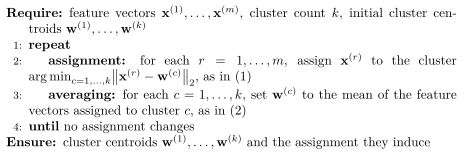
pythondemos/kmeans.py
The clustering error is a non-convex function of the cluster centroids: with a single data point at $x = 0$ and two scalar cluster centroids $w^{(1)}, w^{(2)} \in \reals$, it is $\min\big((w^{(1)})^{2}, (w^{(2)})^{2}\big)$, so both $(1, 0)$ and $(0, 1)$ are global optima with value $0$, but their midpoint $(0.5, 0.5)$ gives $0.25$. Solving the optimization problem exactly is NP-hard (Mahajan et al., 2009). Lloyd's algorithm is an approximate method for the $k$-means optimization problem: it never increases the clustering error. Since Lloyd's algorithm might converge to a local minimum of the clustering error, it is typically run several times with different initializations, keeping the run with the smallest clustering error (Hastie et al., 2009, Sect. 14.3.6). A variant of $k$-means referred to as $k$-means++ uses a specific construction of the initial cluster centroids.
Like the expectation–maximization (EM) algorithm for a Gaussian mixture model (GMM), Lloyd's algorithm is a fixed-point iteration. Collect the cluster centroids in one vector $\weights \defeq \big(\clustercentroid{1}, \ldots, \clustercentroid{\nrcluster}\big)$. One iteration, the assignment step \(\eqref{equ_kmeans_assign_dict}\) followed by the averaging step \(\eqref{equ_kmeans_average_dict}\), applies an operator $\fixedpointop$ to the current cluster centroids, so the method is the fixed-point iteration $\weights^{(\iteridx+1)} = \fixedpointop\big(\weights^{(\iteridx)}\big)$. The fixed points of $\fixedpointop$ are cluster centroids that each coincide with the mean of the data points assigned to them. Convergence follows from monotone descent rather than from a contractive operator property: each of the two steps minimizes the clustering error over one set of variables with the other held fixed, so applying $\fixedpointop$ never increases the clustering error. A finite dataset admits only finitely many partitions, so the iterates reach a fixed point after finitely many iterations (Selim and Ismail, 1984). On the patches of Fig. 1, Lloyd's algorithm reached a fixed point after $12$ iterations, and the clustering error never increased along the way.
B-gmmLloyd's algorithm for $k$-means is the limit of the EM algorithm for a GMM under additional constraints. Fix every cluster probability of the GMM at $1/\nrcluster$ and every covariance matrix at $\sigma^{2} \mI$, a multiple of the identity matrix with one common $\sigma^{2}$. The posterior distribution of the cluster index then depends on $\featurevec$ only through its Euclidean distances to the means, and as $\sigma^{2}$ shrinks towards $0$ it concentrates on the closest one. In the limit ($\sigma^{2} \to 0$), the E-step of EM becomes the assignment step \(\eqref{equ_kmeans_assign_dict}\) and the M-step becomes the averaging step \(\eqref{equ_kmeans_average_dict}\) of Lloyd's algorithm. On the patches of Fig. 1 with $\sigma^{2} = 10^{-4}$, the EM algorithm assigns $99.4\%$ of the patches like $k$-means. Leaving the covariance matrices and the cluster probabilities free is what lets a GMM provide a degree of belonging where $k$-means assigns each data point to one cluster.
B-mediansThe loss function is what separates $k$-means from its generalizations, and it decides what the averaging step of Lloyd's algorithm computes. Replacing the squared Euclidean distance by the Euclidean distance itself, $\lossfunc{\featurevec}{\hypothesis} = \normgeneric{\featurevec - \hypothesis(\featurevec)}{2}$, gives the $k$-medians optimization problem. The assignment step \(\eqref{equ_kmeans_assign_dict}\) is unchanged, since the nearest cluster centroid is the same under both losses, but the averaging step \(\eqref{equ_kmeans_average_dict}\) becomes the geometric median (GM) of the data points assigned to a cluster, which has no closed form and is computed by Weiszfeld's fixed-point iteration (Weiszfeld, 1937). The gain is robustness to outliers: adding $10$ far-away patches to the $566$ patches of the vegetation cluster of Fig. 1 moves their mean by $0.044$ but their GM by $0.004$, while $k$-medians assigns $98.5\%$ of the patches like $k$-means.
The averaging step is not tied to the squared Euclidean distance alone: for any Bregman divergence $\lossfunc{\featurevec}{\hypothesis} = \bregmandiv{\featurevec}{\hypothesis(\featurevec)}{\phi}$ as loss, the mean of the assigned data points still minimizes their summed loss, so only the assignment step changes (Banerjee et al., 2005). The Euclidean distance is not a Bregman divergence, which is why it changes the averaging step. Restricting each cluster centroid to be one of the data points assigned to it gives $k$-medoids, which uses only the pairwise distances between data points and therefore applies to data points without numeric feature vectors (Kaufman and Rousseeuw, 1990).
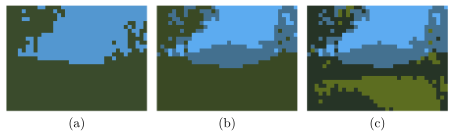
Fig. 3 shows the effect of the number
$\nrcluster$ of clusters on the patches of
Fig. 1. Each patch is painted with the
average color of its cluster, which is
image segmentation. With $\nrcluster = 2$, the sky and the
mountain are separated from the vegetation. With
$\nrcluster = 3$, the mountain and haze form their own
cluster. With $\nrcluster = 4$, the vegetation splits into
the sunlit meadow and the dark foliage. The clustering error
decreases with $\nrcluster$, from $0.034$ for $\nrcluster = 2$
to $0.018$ for $\nrcluster = 3$ and $0.011$ for
$\nrcluster = 4$, and it reaches $0$ when every data point
is its own cluster centroid.
pythondemos/kmeans.py
Synonyms: $k$-means clustering.
See also: hard clustering, clustering, cluster, cluster centroid, clustering error, Lloyd's algorithm, fixed-point iteration, $k$-means++, Euclidean distance, empirical risk minimization, hypothesis space, loss function, Gaussian mixture model, expectation–maximization, soft clustering, degree of belonging, geometric median, Bregman divergence.
@misc{dictml_kmeans,
  author = {Jung, Alexander},
  editor = {Olioumtsevits, Konstantina and Schnoor, Ekkehard},
  title = {$k$-means},
  howpublished = {Dictionary of Applied Machine Learning (course edition)},
  year = {2026},
  doi = {10.5281/zenodo.21569296},
  note = {ISBN 978-952-64-3013-3, CC BY 4.0, retrieved 2026-10-27},
  url = {https://dictionaryofml.org/terms/kmeans.html}
}