Dictionary of Applied Machine Learning
Updated on 2026-07-01
Typeset PDF version — the authoritative form of this entry
Python demo — a script that recomputes what this entry states and prints one line per check
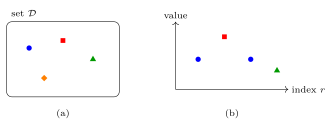
A dataset is a finite collection of data points on which model training and validation are performed. Strictly speaking, a dataset is a set of distinct data points. With slight abuse of terminology, the term is also used interchangeably with sample, a finite sequence that may contain repetitions. In practice, machine learning (ML) methods often do not have access to the actual dataset. Instead, they must use approximate representations such as tables in the relational model.
P-setsampleA dataset is a collection
$\dataset = \{\datapoint^{(1)}, \ldots, \datapoint^{(\samplesize)}\}$ of
data points. Machine learning (ML) methods use a dataset for model
training and validation. Strictly speaking, a dataset is an
unordered collection of distinct data points, i.e., a set with no
repetitions. In ML literature, however, the term is often used for
a sample: a sequence of $\samplesize$ data points,
indexed by $\sampleidx = 1, \ldots, \samplesize$, that may contain
repetitions (see Fig. 1).
In practice, a dataset is represented within some data model, a rigorous formalism for representing and processing data (Abiteboul et al., 1995; Hoberman, 2009; Ramakrishnan and Gehrke, 2002; Silberschatz et al., 2019). For example, the relational model organizes data as a collection of tables, or relations (Codd, 1970; Silberschatz et al., 2019).
P-tableA single table consists of rows and columns, where each row corresponds
to a single data point and each column represents a specific
attribute of a data point. The order of rows is immaterial, and each
attribute is associated with a domain that specifies its set of
admissible values. ML methods use these attributes as the
features or the label of a data point, so the attribute
domains correspond to the feature space and the
label space. Table 3 shows an example obtained
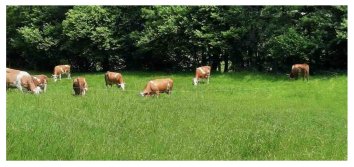
from the dataset in Fig. 2.

Trustworthy artificial intelligence (trustworthy AI) also requires documenting how a dataset was assembled, for example through a datasheet that records the dataset's motivation, composition, and collection process (Gebru et al., 2021). When the data points are personal data, this becomes a legal duty: under the purpose limitation principle, the general data protection regulation (GDPR) requires that such data be collected for "specified, explicit and legitimate purposes" that are fixed at the time of collection (European Parliament and Council of the European Union, 2016, Art. 5(1)(b)).
See also: data point, sample, data, relational model, feature, feature space, label space, EU AI Act.
@misc{dictml_dataset,
  author = {Jung, Alexander},
  editor = {Olioumtsevits, Konstantina and Schnoor, Ekkehard},
  title = {dataset},
  howpublished = {Dictionary of Applied Machine Learning (course edition)},
  year = {2026},
  doi = {10.5281/zenodo.21569296},
  note = {ISBN 978-952-64-3013-3, CC BY 4.0, retrieved 2026-09-22},
  url = {https://dictionaryofml.org/terms/dataset.html}
}