Dictionary of Applied Machine Learning
Updated on 2026-09-16
Typeset PDF version — the authoritative form of this entry
Python demo — a script that recomputes what this entry states and prints one line per check
In machine learning (ML), the word model is used in different ways. Formally, a model is a hypothesis space $\hypospace$: the set of candidate hypothesis maps from which an ML method picks (or learns) one. In applied ML literature and in software libraries, the word model also refers to the trained predictor, i.e., to the learned hypothesis returned by an ML algorithm; the EU AI Act uses this sense in the compound term general-purpose AI model (GPAI model). A different type of mathematical model is a probabilistic model, which specifies a family of probability distributions that characterize a data generation process.
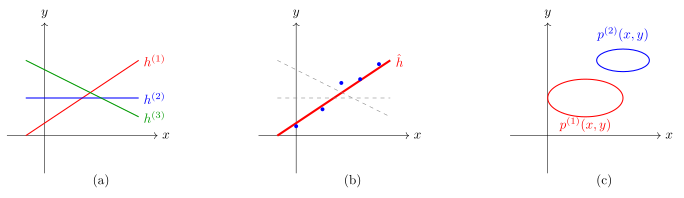
P-hypospaceConsider the problem of predicting tomorrow's maximum daytime temperature from today's morning temperature. Machine learning (ML) methods learn a hypothesis map $\learnthypothesis$ that reads in today's morning temperature and delivers an accurate prediction of tomorrow's maximum temperature. This learned hypothesis is chosen from a (typically large) set of candidate hypothesis maps, i.e., a hypothesis space $\hypospace$.
The hypothesis space underlying an ML application is often referred to as the model of the method (Goodfellow et al., 2016, Sect. 5.1). For example, linear regression and logistic regression use the linear model as their hypothesis space. A decision tree method uses a hypothesis space that consists of hypothesis maps generated by a flow chart. Large language model (LLM) systems use a hypothesis space consisting of non-linear maps represented by an artificial neural network (ANN).
P-trainedModel training refers to the process of finding a hypothesis in the hypothesis space that yields accurate predictions. Strictly speaking, a trained (or fitted) model represents a learned hypothesis $\learnthypothesis$. In applied ML literature and in software libraries, the word model typically refers to a trained model, i.e., to a specific hypothesis map $\learnthypothesis$ (Goodfellow et al., 2016, Sect. 5.1; Murphy, 2012, Sect. 3.5.2; Prince, 2023). The EU AI Act uses the word model in the same sense (i.e., a learned hypothesis) in the compound term general-purpose AI model (GPAI model) (Parliament and Union, 2024, Art. 3(63)).
P-probmodelA different type of mathematical model is a probabilistic model, which specifies a family of probability distributions. Each such probability distribution defines a data generator: data points are realizations of independent and identically distributed (i.i.d.) random variables (RVs) with the given probability distribution.
Fig. 1 illustrates these three uses of
the word model: the hypothesis space, the trained
model, and the probabilistic model.
See also: hypothesis space, hypothesis, model parameter, parametric model, training, empirical risk minimization, probabilistic model, probability distribution, decision tree, neuron, artificial neural network, transformer, large language model, general-purpose AI model, artificial intelligence system.
@misc{dictml_model,
  author = {Jung, Alexander},
  editor = {Olioumtsevits, Konstantina and Schnoor, Ekkehard},
  title = {model},
  howpublished = {Dictionary of Applied Machine Learning (course edition)},
  year = {2026},
  doi = {10.5281/zenodo.21569296},
  note = {ISBN 978-952-64-3013-3, CC BY 4.0, retrieved 2026-09-21},
  url = {https://dictionaryofml.org/terms/model.html}
}