pythondemos/probdist.pyDictionary of Applied Machine Learning
Updated on 2026-09-17
Typeset PDF version — the authoritative form of this entry
Python demo — a script that recomputes what this entry states and prints one line per check
A probability distribution assigns probabilities to the possible values of a random variable (RV). A machine learning (ML) method reads in a dataset and delivers an output, such as a learned hypothesis or the prediction for a given data point, and should work well for any dataset that is typical for the ML application at hand. One widely used construction of a typical dataset is as realizations of independent and identically distributed (i.i.d.) RVs with a common probability distribution, postulated from domain knowledge or estimated from a dataset. The probability distribution of a binary RV is fully specified by a single probability, that of a continuous real-valued RV may be specified by a probability density function (pdf), and in the most general case by a probability measure.
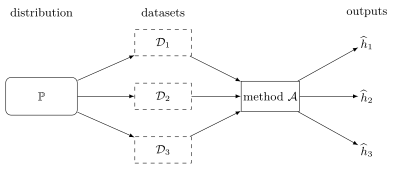
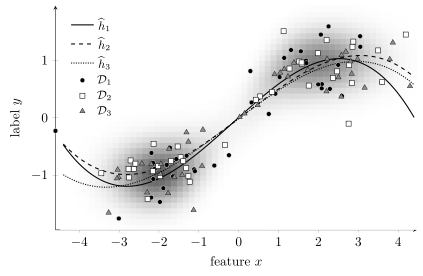
Consider a machine learning (ML) method that reads in a dataset $\dataset = \big\{ \datapoint^{(1)}, \,\ldots, \,\datapoint^{(\samplesize)} \big\}$ and delivers an output, such as a learned hypothesis $\learnthypothesis$ or the prediction for a given data point. Feeding a different dataset into the same method can deliver a different output. In general, the method should work well for any dataset that is typical for the ML application at hand. One widely used construction of a typical dataset is as independent and identically distributed (i.i.d.) random variables (RVs) $\datapoint^{(1)}, \,\ldots, \,\datapoint^{(\samplesize)} \sim \probdist$ with a common probability distribution $\probdist$ (see Fig. 1).
P-typicalThe probability distribution $\probdist$ decides which sequences of data points (or datasets) are typical. The distribution $\probdist$ is never observed; only the dataset is. In practice, $\probdist$ can be postulated based on domain knowledge or estimated from a dataset, e.g., by its empirical distribution or histogram, or by maximum likelihood within a parametric family.
P-pictureHow a probability distribution is specified depends on the values the
RV takes. The probability distribution of a binary RV
$\truelabel \in \{0,1\}$ is fully specified by the single
probability $\prob{\truelabel = 0}$, since
$\prob{\truelabel=1} = 1-\prob{\truelabel=0}$; more generally, an
RV with finitely many values is specified by a probability mass function (pmf). The
probability distribution of a continuous real-valued RV
$\feature \in \reals$ might be specified by a probability density function (pdf)
$\pdf{\feature}{\cdot}$, for which
$\prob{ \feature \in [a,b] } \approx \pdf{\feature}{a} \, |b-a|$
holds for a short interval $[a,b]$. In the most general case, an
RV is a map $\datapoint: \samplespace \to
\datapointspace$ from a probability space
$(\samplespace, \sigmaalgebra, \prob{\cdot})$ to its value
space $\datapointspace$. The probability distribution of
$\datapoint$ is the measure that $\datapoint$ induces on
$\datapointspace$: it assigns to a measurable subset
$\mathcal{B} \subseteq \datapointspace$ the probability
$\prob{\datapoint \in \mathcal{B}}$
(Billingsley, 1986; Gray, 2009;
Kallenberg, 1997).
pythondemos/probdist.py
See also: independent and identically distributed, realization, random variable, probability, probability density function, probability mass function, probability measure, probability space, empirical distribution, expectation, generalization.
@misc{dictml_probdist,
  author = {Jung, Alexander},
  editor = {Olioumtsevits, Konstantina and Schnoor, Ekkehard},
  title = {probability distribution},
  howpublished = {Dictionary of Applied Machine Learning (course edition)},
  year = {2026},
  doi = {10.5281/zenodo.21569296},
  note = {ISBN 978-952-64-3013-3, CC BY 4.0, retrieved 2026-09-21},
  url = {https://dictionaryofml.org/terms/probdist.html}
}