Dictionary of Applied Machine Learning
Updated on 2026-09-04
Typeset PDF version — the authoritative form of this entry
Python demo — a script that recomputes what this entry states and prints one line per check
A data point is the elementary information-carrying unit on which machine learning (ML) methods operate. The properties of a data point fall into two categories: features, which are easily measurable or computable, and labels, which are higher-level facts that typically can only be determined using human expertise. Whether a given property is treated as a feature or a label is a design choice that depends on the ML application.
A data point is an object that conveys information (Cover and Thomas, 2006); such objects are the elementary units on which machine learning (ML) methods operate. Examples include students, radio signals, trees, images, random variables (RVs), real numbers, or proteins. Data points of the same type are described by two categories of properties.
P-featlabThe first category includes features that are measurable or computable properties of a data point. They can be automatically extracted or computed using sensors, computers, or other data collection systems. The second category includes labels that are higher-level facts, or quantities of interest, that typically require human expertise or domain knowledge to determine rather than being directly measurable. Whether a given property serves as a feature or a label is ultimately a design choice that depends on the resources available in a given ML application.
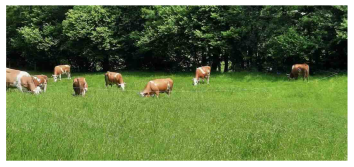
P-imageFig. 1 shows an image as an
example of a data point. Several properties of the image can serve
as features: the color intensities $x_{1}, \ldots, x_{\nrfeatures}$
of all image pixels, the timestamp $x_{\nrfeatures+1}$ of the image
capture, and the spatial location $x_{\nrfeatures+2}$ of the image
capture. Higher-level facts can serve as labels: the number of
cows $\truelabel_{1}$, the number of wolves $\truelabel_{2}$, and the
condition of the pasture $\truelabel_{3}$ (e.g., healthy or overgrazed).
Both kinds of properties are error-prone. For many ML applications, it is rarely possible to access the true labels. For example, a medical expert's diagnosis can be wrong, rendering it a noisy proxy for the patient's true condition. Errors of this kind, called label noise, arise whenever a label is only a proxy for the true quantity of interest, whether that proxy is produced by human judgment or by an automated system.
Features are also a source of error within an ML method. A feature is obtained by measuring or computing a property of a data point. Physical and chemical sensing devices have a finite measurement uncertainty (Kimothi, 2002), and computing a feature on a finite computer introduces rounding errors (Golub and Loan, 2013, Sect. 2.7). These imperfections make the recorded value deviate from the true feature value. This discrepancy is feature noise.
P-labelnoiseML methods should be robust to both feature and label noise. Their predictions on new data points should not degrade sharply when some features or labels in the training set are corrupted. The EU AI Act reflects this concern: training data must, to the best extent possible, be "free of errors" (Parliament and Union, 2024, Art. 10(3)), and high-risk artificial intelligence systems (high-risk AI systems) must attain an appropriate level of robustness (Parliament and Union, 2024, Art. 15(1)).
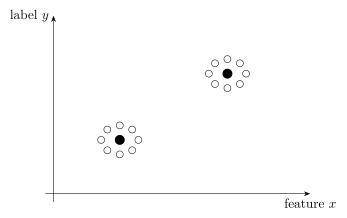
P-featnoiseRobustness to feature and label noise can be improved by data augmentation,
which deliberately perturbs the features or the label of a
training data point (see Fig. 2).
Training on such perturbed data points acts as
regularization and reduces the influence of
corrupted feature or label values
on the learned hypothesis.
@misc{dictml_datapoint,
  author = {Jung, Alexander},
  editor = {Olioumtsevits, Konstantina and Schnoor, Ekkehard},
  title = {data point},
  howpublished = {Dictionary of Applied Machine Learning (course edition)},
  year = {2026},
  doi = {10.5281/zenodo.21569296},
  note = {ISBN 978-952-64-3013-3, CC BY 4.0, retrieved 2026-09-21},
  url = {https://dictionaryofml.org/terms/datapoint.html}
}