Dictionary of Applied Machine Learning
Updated on 2026-09-14
Typeset PDF version — the authoritative form of this entry
Python demo — a script that recomputes what this entry states and prints one line per check
The word data carries three main senses in machine learning (ML). In a general sense, it denotes an abstract raw material that is used (or consumed) by ML methods. As a data point, it is an elementary information-carrying unit; as a dataset, it is an indexed collection of data points. A related regulatory term, personal data, is defined in the general data protection regulation (GDPR) and the EU AI Act.
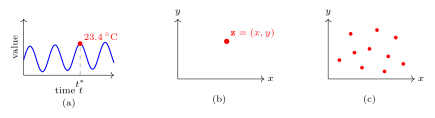
P-recordA weather station measures the temperature at its location and stores the value $23.4\,^{\circ}\mathrm{C}$ together with a timestamp (see Fig. 1(a)). Such recorded values are data: representations of information, recorded in a form suitable for storage, communication, and processing by machine learning systems (ML systems) (Standardization and Commission, 2015). Every machine learning (ML) method fits a model to data, and the usefulness of the hypothesis the method learns is limited by the quality and quantity of the available data.
The word data is used in three technical senses, summarized in Fig. 1, and additionally in a legal sense. In its broadest use, data refer to recorded information. This sense applies when the distinction between unit and collection is irrelevant. Examples are raw sensor measurements such as the temperature reading in Fig. 1(a) and compound terms such as data parallelism, networked data, and data augmentation.
P-datapointAs a formal unit, a data point is the fundamental information-carrying unit (Fig. 1(b)). Its information is contained in two types of properties: features (easy to measure or compute) and labels (difficult to measure or compute, or in need of human annotation) (Shalev-Shwartz and Ben-David, 2014, Ch. 2).
P-datasetAs a formal collection, a dataset
$\dataset = \{\datapoint^{(1)}, \ldots, \datapoint^{(\samplesize)}\}$
is the indexed collection of data points on which model
training and validation are performed
(Fig. 1(c)) (Goodfellow et al., 2016, Sect. 5.1).
See also: data point, dataset, model, hypothesis, general data protection regulation, EU AI Act, personal data.
@misc{dictml_data,
  author = {Jung, Alexander},
  editor = {Olioumtsevits, Konstantina and Schnoor, Ekkehard},
  title = {data},
  howpublished = {Dictionary of Applied Machine Learning (course edition)},
  year = {2026},
  doi = {10.5281/zenodo.21569296},
  note = {ISBN 978-952-64-3013-3, CC BY 4.0, retrieved 2026-09-21},
  url = {https://dictionaryofml.org/terms/data.html}
}