Dictionary of Applied Machine Learning
Updated on 2026-10-07
See also feature data point kernel method Hilbert space
A feature vector is a list of numbers describing a data point, with one entry for each of its features. A feature is an attribute of the data point that is measured or computed without human supervision, so the length of the vector is the number of such attributes. A feature transformation computes the feature vector from the data point and delivers a point of the feature space, which a hypothesis map then reads to predict the label. Non-numeric features enter as numbers: a binary attribute as $0$ or $1$, a categorical one through one-hot encoding. Most machine learning (ML) methods use feature vectors in a Euclidean space whose dimension is the number of features. A feature vector can more generally be an element of a Hilbert space, which is how a kernel method uses one without ever forming it, reaching it only through inner products.
B-houseA house offered for sale can be described to a machine learning (ML) method by three numbers: $85$ square meters of living area, $3$ rooms, and $1974$ as the year of construction. That list $\big(85, 3, 1974\big)$ is the feature vector of the house. In general, a feature vector gathers into one vector the features of a data point, those attributes of the data point that are measured or computed without human supervision (Duda et al., 2001). A list of $\nrfeatures$ real numbers, for a natural number $\nrfeatures$, is an element of the Euclidean space $\reals^{\nrfeatures}$ (Strang, 2016, Sect. 1.1).
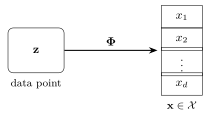
B-encodeThe feature vector of a data point $\datapoint$ is written
$\featurevec = \big(\feature_{1}, \,\ldots,
\,\feature_{\nrfeatures}\big)^{\top}$, and its entry
$\feature_{\featureidx}$ is one feature of that
data point. It is obtained from the data point by a
feature transformation
$\featuretrafovec : \datapointspace \rightarrow \featurespace$,
$\featurevec = \featuretrafovec(\datapoint)$, which views the
data point itself as its raw features and delivers a
point of the feature space $\featurespace$
(Fig. 1). A hypothesis map reads the
feature vector and delivers a prediction of the label of
the data point.
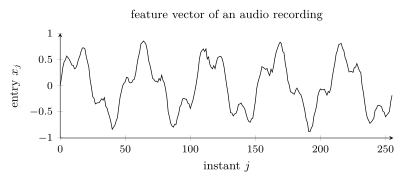
B-textA feature transformation also reaches data points that
are not records of numbers. A text becomes a feature vector by
counting how often each entry of a fixed word list appears in it,
which gives one entry per listed word. A digital image is an
array of pixels, and the red, green and blue intensities of
those pixels become one entry each. An audio recording becomes a
feature vector through the values its signal takes at
successive instants, one entry per instant. The
feature transformation differs in each case, and so does the
dimension $\nrfeatures$ of the resulting
feature space: the house above needs seven entries once its
balcony and heating type are encoded, while an audio recording read
at $256$ instants needs $256$
(Fig. 2).
pythondemos/featurevec.py
Synonyms: covariate vector, input vector, predictor vector.
See also: feature, feature space, feature transformation, data point, vector, Euclidean space, kernel, reproducing kernel Hilbert space, kernel method, Hilbert space.
@misc{dictml_featurevec,
  author = {Jung, Alexander},
  editor = {Olioumtsevits, Konstantina and Schnoor, Ekkehard},
  title = {feature vector},
  howpublished = {Dictionary of Applied Machine Learning (course edition)},
  year = {2026},
  doi = {10.5281/zenodo.21569296},
  note = {ISBN 978-952-64-3013-3, CC BY 4.0, retrieved 2026-10-07},
  url = {https://dictionaryofml.org/terms/featurevec.html}
}