B-dims writes when the script runsDictionary of Applied Machine Learning · feature vector
Numerical companion to the entry feature vector: it recomputes what the entry states and prints one line per check
Every block builds a feature vector as a one-dimensional numpy array, for a different kind of data point, and checks that the array is what the entry says a feature vector is: a point of a Euclidean space whose dimension is the number of features. Self-contained (numpy/matplotlib only), fixed seed.
Run it without installing anything:uv run https://dictionaryofml.org/terms/featurevec.py
uv downloads this script and the pinned NumPy and Matplotlib it needs, then runs it; the script fetches any input file it uses. To keep the output files, download featurevec.py into a folder and run uv run featurevec.py there. With NumPy and Matplotlib already installed, python3 featurevec.py, from any directory — it writes its output files into the current directory. Fixed seeds, so the printed numbers reproduce exactly. Download featurevec.py · Notebook · Open in Colab
One cell per block of the script: the code, and what that code printed when it last ran here
"""
featurevec.py -- numerical companion to the glossary entry 'feature vector'.

Every block builds a feature vector as a one-dimensional numpy array, for a
different kind of data point, and checks that the array is what the entry
says a feature vector is: a point of a Euclidean space whose dimension is
the number of features. Self-contained (numpy/matplotlib only), fixed seed.

Blocks
------
[B-house]  The entry's house offered for sale: living area, number of
           rooms and year of construction give the feature vector
           (85, 3, 1974), a point of R^3.
[B-encode] Non-numeric features of the same house: a binary feature (does
           it have a balcony) as 0 or 1, and a categorical feature with
           K = 3 values (the heating type) one-hot encoded into K entries
           of which exactly one equals 1. The house now sits in R^7.
[B-text]   A text data point (a sentence of the Universal Declaration of
           Human Rights): counting how often each word of a fixed word
           list occurs gives one entry per word.
[B-image]  An image data point: the red, green and blue intensities of its
           pixels, one entry per intensity. The feature transformation
           loses nothing here, so the image is recovered from its feature
           vector by reshaping it.
[B-audio]  An audio data point: the values its signal takes at successive
           instants, one entry per instant.
[B-dims]   The five feature vectors are points of Euclidean spaces of very
           different dimension, although one feature transformation
           produced each of them.

Outputs
-------
featurevec_audio.csv : index j and entry x_j of the audio feature vector.
featurevec_dims.csv  : kind of data point and dimension of its feature space.
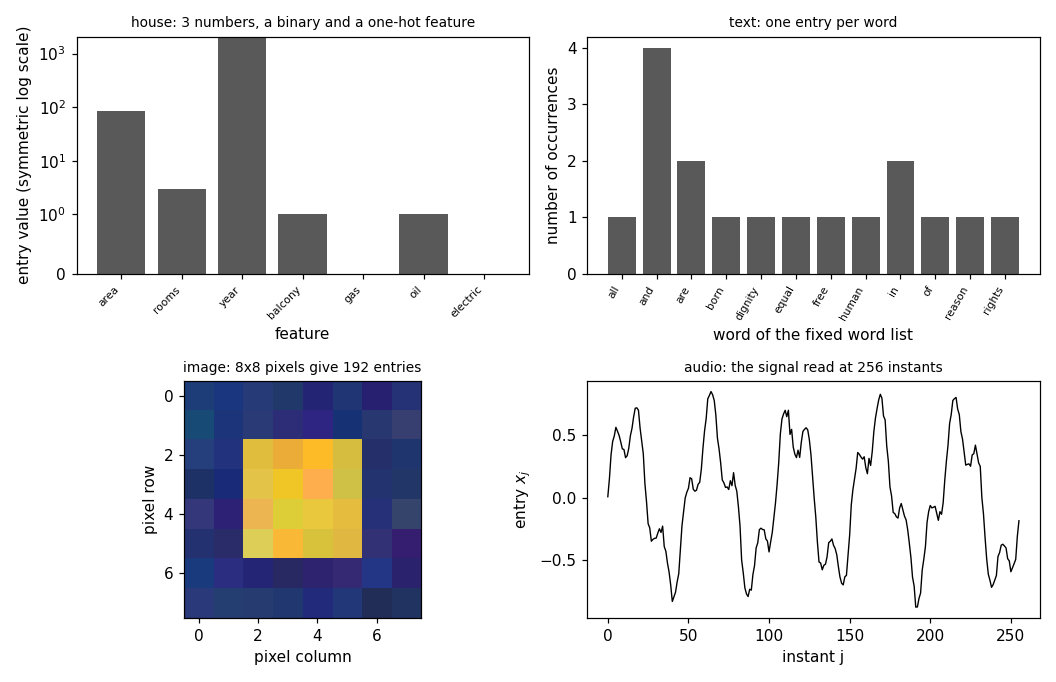
featurevec.png       : preview of all five feature vectors (checking only).

Data generated by pythondemos/featurevec.py.
"""

import numpy as np
import matplotlib

matplotlib.use("Agg")
import matplotlib.pyplot as plt
from pathlib import Path

OUT_DIR = Path(__file__).parent
rng = np.random.default_rng(20261007)

report = []


def check(name, ok):
    report.append((name, bool(ok)))
    print(f"  [{'ok' if ok else 'FAIL'}] {name}")


def is_feature_vector(x, d):
    """A feature vector is a one-dimensional array of d real numbers."""
    return (isinstance(x, np.ndarray) and x.ndim == 1 and x.shape == (d,)
            and np.issubdtype(x.dtype, np.floating) and np.all(np.isfinite(x)))
The entry's house offered for sale: living area, number of rooms and year of construction give the feature vector (85, 3, 1974), a point of R^3.
print("[B-house] a house offered for sale")

house = np.array([85.0, 3.0, 1974.0])
print(f"    living area {house[0]:.0f} m^2, {house[1]:.0f} rooms, "
      f"built {house[2]:.0f}  ->  x = {house}")
check("[B-house] the house is a point of R^3", is_feature_vector(house, 3))
check("[B-house] its entries are the three features in order",
      np.array_equal(house, np.array([85.0, 3.0, 1974.0])))
[B-house] a house offered for sale
    living area 85 m^2, 3 rooms, built 1974  ->  x = [  85.    3. 1974.]
  [ok] [B-house] the house is a point of R^3
  [ok] [B-house] its entries are the three features in order
Non-numeric features of the same house: a binary feature (does it have a balcony) as 0 or 1, and a categorical feature with K = 3 values (the heating type) one-hot encoded into K entries of which exactly one equals 1. The house now sits in R^7.
print("\n[B-encode] a binary and a categorical feature of the same house")

HEATING = ["gas", "oil", "electric"]


def encode_house(area, rooms, year, balcony, heating):
    onehot = np.zeros(len(HEATING))
    onehot[HEATING.index(heating)] = 1.0
    return np.concatenate([[area, rooms, year, float(balcony)], onehot])


house_enc = encode_house(85, 3, 1974, balcony=True, heating="oil")
onehot_part = house_enc[4:]
print(f"    balcony -> {house_enc[3]:.0f}; heating 'oil' -> {onehot_part}")
check("[B-encode] the encoded house is a point of R^7",
      is_feature_vector(house_enc, 7))
check("[B-encode] the binary feature is 0 or 1", house_enc[3] in (0.0, 1.0))
check("[B-encode] exactly one of the K = 3 one-hot entries equals 1",
      onehot_part.sum() == 1.0 and set(np.unique(onehot_part)) <= {0.0, 1.0})
check("[B-encode] the position of that entry names the value",
      HEATING[int(np.argmax(onehot_part))] == "oil")
[B-encode] a binary and a categorical feature of the same house
    balcony -> 1; heating 'oil' -> [0. 1. 0.]
  [ok] [B-encode] the encoded house is a point of R^7
  [ok] [B-encode] the binary feature is 0 or 1
  [ok] [B-encode] exactly one of the K = 3 one-hot entries equals 1
  [ok] [B-encode] the position of that entry names the value
A text data point (a sentence of the Universal Declaration of Human Rights): counting how often each word of a fixed word list occurs gives one entry per word.
print("\n[B-text] a text data point")

TEXT = ("All human beings are born free and equal in dignity and rights. "
        "They are endowed with reason and conscience and should act "
        "towards one another in a spirit of brotherhood.")
WORD_LIST = ["all", "and", "are", "born", "dignity", "equal",
             "free", "human", "in", "of", "reason", "rights"]


def text_features(sentence, words):
    seen = sentence.lower().replace(".", " ").replace(",", " ").split()
    return np.array([float(seen.count(w)) for w in words])


text_vec = text_features(TEXT, WORD_LIST)
print(f"    {len(WORD_LIST)} words counted; "
      f"'and' occurs {text_vec[WORD_LIST.index('and')]:.0f} times")
check("[B-text] the text is a point of R^12",
      is_feature_vector(text_vec, len(WORD_LIST)))
check("[B-text] every entry is a non-negative whole count",
      np.all(text_vec >= 0) and np.all(text_vec == np.round(text_vec)))
check("[B-text] the counts match a direct count of the words",
      text_vec.sum() == sum(TEXT.lower().replace(".", " ").replace(",", " ")
                            .split().count(w) for w in WORD_LIST))
[B-text] a text data point
    12 words counted; 'and' occurs 4 times
  [ok] [B-text] the text is a point of R^12
  [ok] [B-text] every entry is a non-negative whole count
  [ok] [B-text] the counts match a direct count of the words
An image data point: the red, green and blue intensities of its pixels, one entry per intensity. The feature transformation loses nothing here, so the image is recovered from its feature vector by reshaping it.
print("\n[B-image] an image data point")

HEIGHT, WIDTH = 8, 8
rows, cols = np.mgrid[0:HEIGHT, 0:WIDTH]
# a bright disc on a darker ground, so the pixels show a shape rather than noise
disc = ((rows - 3.5) ** 2 + (cols - 3.5) ** 2) <= 2.5 ** 2
image = np.empty((HEIGHT, WIDTH, 3))
image[..., 0] = np.where(disc, 0.90, 0.15) + 0.04 * rng.normal(size=(HEIGHT, WIDTH))
image[..., 1] = np.where(disc, 0.75, 0.20) + 0.04 * rng.normal(size=(HEIGHT, WIDTH))
image[..., 2] = np.where(disc, 0.25, 0.45) + 0.04 * rng.normal(size=(HEIGHT, WIDTH))
image = np.clip(image, 0.0, 1.0)
image_vec = image.reshape(-1)
print(f"    {HEIGHT} x {WIDTH} pixels, 3 intensities each  ->  "
      f"{image_vec.size} entries")
check("[B-image] the image is a point of R^192",
      is_feature_vector(image_vec, HEIGHT * WIDTH * 3))
check("[B-image] every intensity lies between 0 and 1",
      np.all(image_vec >= 0.0) and np.all(image_vec <= 1.0))
check("[B-image] reshaping the feature vector recovers the image",
      np.array_equal(image_vec.reshape(HEIGHT, WIDTH, 3), image))
[B-image] an image data point
    8 x 8 pixels, 3 intensities each  ->  192 entries
  [ok] [B-image] the image is a point of R^192
  [ok] [B-image] every intensity lies between 0 and 1
  [ok] [B-image] reshaping the feature vector recovers the image
An audio data point: the values its signal takes at successive instants, one entry per instant.
print("\n[B-audio] an audio data point")

NR_INSTANTS = 256
instants = np.arange(NR_INSTANTS)
audio_vec = (0.6 * np.sin(2 * np.pi * 5 * instants / NR_INSTANTS)
             + 0.25 * np.sin(2 * np.pi * 17 * instants / NR_INSTANTS)
             + rng.normal(0.0, 0.03, NR_INSTANTS))
print(f"    the signal is read at {NR_INSTANTS} instants  ->  "
      f"{audio_vec.size} entries, largest magnitude "
      f"{np.abs(audio_vec).max():.2f}")
check("[B-audio] the recording is a point of R^256",
      is_feature_vector(audio_vec, NR_INSTANTS))
check("[B-audio] every entry stays within the range of the signal",
      np.all(np.abs(audio_vec) <= 1.0))
recomputed = (0.6 * np.sin(2 * np.pi * 5 * 40 / NR_INSTANTS)
              + 0.25 * np.sin(2 * np.pi * 17 * 40 / NR_INSTANTS))
check("[B-audio] entry j holds the value read at instant j",
      abs(audio_vec[40] - recomputed) < 0.15)
[B-audio] an audio data point
    the signal is read at 256 instants  ->  256 entries, largest magnitude 0.88
  [ok] [B-audio] the recording is a point of R^256
  [ok] [B-audio] every entry stays within the range of the signal
  [ok] [B-audio] entry j holds the value read at instant j
The five feature vectors are points of Euclidean spaces of very different dimension, although one feature transformation produced each of them.
print("\n[B-dims] one construction, feature spaces of very different size")

KINDS = [("house", house), ("house, encoded", house_enc),
         ("text", text_vec), ("image", image_vec), ("audio", audio_vec)]
for name, vec in KINDS:
    print(f"    {name:16s} d = {vec.size}")
dims = [vec.size for _, vec in KINDS]
check("[B-dims] each data point became a one-dimensional array",
      all(v.ndim == 1 for _, v in KINDS))
check("[B-dims] the dimensions differ by about two orders of magnitude",
      min(dims) == 3 and max(dims) == 256)

with open(OUT_DIR / "featurevec_audio.csv", "w") as fh:
    fh.write("j,x\n")
    for j, value in enumerate(audio_vec):
        fh.write(f"{j},{value:.4f}\n")

with open(OUT_DIR / "featurevec_dims.csv", "w") as fh:
    fh.write("kind,d\n")
    for name, vec in KINDS:
        fh.write(f"{name.replace(',', '')},{vec.size}\n")


# ---------------------------------------------------------------- preview
fig, axs = plt.subplots(2, 2, figsize=(9.6, 6.2))

ax_house = axs[0, 0]
labels = ["area", "rooms", "year", "balcony", "gas", "oil", "electric"]
ax_house.bar(np.arange(house_enc.size), house_enc, color="0.35")
ax_house.set_xticks(np.arange(house_enc.size))
ax_house.set_xticklabels(labels, rotation=45, ha="right", fontsize=7)
ax_house.set_yscale("symlog", linthresh=1.0)
ax_house.set_xlabel("feature")
ax_house.set_ylabel("entry value (symmetric log scale)")
ax_house.set_title("house: 3 numbers, a binary and a one-hot feature",
                   fontsize=9)

ax_text = axs[0, 1]
ax_text.bar(np.arange(text_vec.size), text_vec, color="0.35")
ax_text.set_xticks(np.arange(text_vec.size))
ax_text.set_xticklabels(WORD_LIST, rotation=60, ha="right", fontsize=7)
ax_text.set_xlabel("word of the fixed word list")
ax_text.set_ylabel("number of occurrences")
ax_text.set_title("text: one entry per word", fontsize=9)

ax_img = axs[1, 0]
ax_img.imshow(image, interpolation="nearest")
ax_img.set_xlabel("pixel column")
ax_img.set_ylabel("pixel row")
ax_img.set_title(f"image: {HEIGHT}x{WIDTH} pixels give "
                 f"{image_vec.size} entries", fontsize=9)

ax_audio = axs[1, 1]
ax_audio.plot(instants, audio_vec, "-", color="black", lw=0.9)
ax_audio.set_xlabel("instant j")
ax_audio.set_ylabel("entry $x_j$")
ax_audio.set_title(f"audio: the signal read at {NR_INSTANTS} instants",
                   fontsize=9)

fig.tight_layout()
fig.savefig(OUT_DIR / "featurevec.png", dpi=110)

n_ok = sum(ok for _, ok in report)
print(f"\n{n_ok}/{len(report)} checks pass")
print("wrote featurevec_audio.csv, featurevec_dims.csv, featurevec.png")
if n_ok != len(report):
    raise SystemExit(1)
[B-dims] one construction, feature spaces of very different size
    house            d = 3
    house, encoded   d = 7
    text             d = 12
    image            d = 192
    audio            d = 256
  [ok] [B-dims] each data point became a one-dimensional array
  [ok] [B-dims] the dimensions differ by about two orders of magnitude

17/17 checks pass
wrote featurevec_audio.csv, featurevec_dims.csv, featurevec.png
B-dims writes when the script runs