Dictionary of Applied Machine Learning
Updated on 2026-06-17
Typeset PDF version — the authoritative form of this entry
Python demo — a script that recomputes what this entry states and prints one line per check
The loss incurred by a hypothesis on a single data point is a scalar that quantifies the error of the hypothesis when evaluated on that data point. The ultimate goal of machine learning (ML) methods is to train a model such that the learned hypothesis delivers predictions with minimum loss. A key characteristic of ML applications and methods is the accessibility of loss values. In supervised learning, the loss can be evaluated for every hypothesis. In reinforcement learning (RL), the loss is observed only for the action actually taken.
P-nonnegIn temperature forecasting, the quality
of a predicted temperature is naturally measured by how far
it deviates from the temperature actually measured the next
day. The loss formalizes this idea. The loss incurred by a
hypothesis $\hypothesis \in \hypospace$ on a single
data point is a scalar that quantifies the error of
$\hypothesis$ when evaluated on that data point
(Shalev-Shwartz and Ben-David, 2014, Sect. 2.1). A smaller loss value
indicates a smaller error. In supervised learning, this
error is the discrepancy between the prediction
$\hypothesis(\featurevec)$ delivered for the features
$\featurevec$ and the label $\truelabel$ of that
data point. Some losses
(e.g., the squared error loss) take a continuum of values, while
others (e.g., the $0/1$ loss) are binary, indicating
only whether the prediction matches the label.
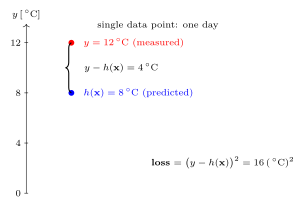
For the temperature forecast, the loss on a given day can be
the squared difference between the predicted temperature
(the prediction) and the measured one (the
label); see Fig. 1.
P-empriskMachine learning (ML) methods use observed loss values to construct an objective function for model training. The average loss across a training set of data points is the empirical risk that empirical risk minimization (ERM) minimizes.
P-accessML applications can be categorized by how the loss values are accessible. In supervised learning, the loss can, in principle, be evaluated for every hypothesis in the hypothesis space, since the true label of each training data point is observed. In reinforcement learning (RL), the situation differs (Sutton and Barto, 2018). At each time step, the ML method (implemented by an agent) selects an action via the currently used hypothesis. The agent then observes the loss incurred by the action actually taken. The loss that would have been incurred by the other actions is not revealed. This limited accessibility of loss values is known as bandit (or partial) feedback (Hazan, 2022, Sect. 6.1). For example, a route-planning system learns the actual travel time only for the route the driver took, not for any alternative route. Similarly, a self-driving car selects a steering direction, and the incurred loss can be measured from onboard sensors such as collision detectors and lane-departure warnings, but only for the trajectory actually driven.
Synonyms: cost.
See also: loss function, logarithmic loss, data point, hypothesis, empirical risk, empirical risk minimization, norm, metric, reinforcement learning, supervised learning, unsupervised learning.
@misc{dictml_loss,
  author = {Jung, Alexander},
  editor = {Olioumtsevits, Konstantina and Schnoor, Ekkehard},
  title = {loss},
  howpublished = {Dictionary of Applied Machine Learning (course edition)},
  year = {2026},
  doi = {10.5281/zenodo.21569296},
  note = {ISBN 978-952-64-3013-3, CC BY 4.0, retrieved 2026-09-21},
  url = {https://dictionaryofml.org/terms/loss.html}
}