Dictionary of Applied Machine Learning
Updated on 2026-09-18
Typeset PDF version — the authoritative form of this entry
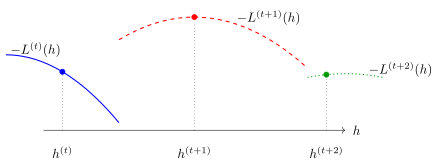
Reinforcement learning (RL) is an online learning setting in which, at each time step $\timeidx$, the loss can be evaluated only for the single hypothesis $\hypothesis^{(\timeidx)}$ actually used. The hypothesis maps the feature vector $\featurevec^{(\timeidx)}$ of the current data point to an action, and the usefulness of that action is reported by a reward $\reward^{(\timeidx)}$, which acts as a noisy estimate of the negative loss. In general the reward depends on earlier actions as well, and the goal is to choose the hypotheses so that the possibly discounted cumulative reward is maximized. Unlike supervised learning, RL never observes the correct label for a data point, only the reward of the action taken.
RL refers to an online learning setting where
it is only possible to evaluate the usefulness of a single hypothesis (i.e., a specific
choice of model parameters) at each time step $\timeidx$. In particular, RL
methods apply the current hypothesis $\hypothesis^{(\timeidx)}$ to the
feature vector $\featurevec^{(\timeidx)}$ of the newly received data point
to predict the next action.
The usefulness of the resulting prediction $\hypothesis^{(\timeidx)}(\featurevec^{(\timeidx)})$
is quantified by a reward signal $\reward^{(\timeidx)}$ (see Fig. 1).
See also: reward, loss function, machine learning.
@misc{dictml_reinforcementlearning,
  author = {Jung, Alexander and Olioumtsevits, Konstantina and Schnoor, Ekkehard},
  title = {reinforcement learning},
  howpublished = {Dictionary of Applied Machine Learning (course edition)},
  year = {2026},
  doi = {10.5281/zenodo.21569296},
  note = {ISBN 978-952-64-3013-3, CC BY 4.0, retrieved 2026-09-19},
  url = {https://dictionaryofml.org/terms/reinforcementlearning.html}
}