pythondemos/norm.pyDictionary of Applied Machine Learning
Updated on 2026-08-31
Typeset PDF version — the authoritative form of this entry
Python demo — a script that recomputes what this entry states and prints one line per check
A norm on a vector space is a function that assigns each vector a nonnegative number, its length. A norm is definite and homogeneous, and it satisfies the triangle inequality. Every norm defines a metric via the norm of the difference of two vectors, and every inner product induces a norm. The $\ell_{p}$-norms on $\reals^{\featuredim}$ include the $\ell_{1}$-norm, the Euclidean norm, and the $\ell_{\infty}$-norm. In machine learning (ML), norms are used to construct loss functions and regularizers.
P-axiomsConsider a data point that is represented by a feature vector $\featurevec \in \reals^{\featuredim}$, e.g., the hourly temperature recordings of one day at a weather station. Many machine learning (ML) methods use a measure for the size of such a vector or for the distance between two of them. A norm provides this measure: a norm $\normgeneric{\, \cdot \,}{}$ on a vector space $\vecspace$ over the field $\reals$ is a function $\normgeneric{\, \cdot \,}{}: \vecspace \to \reals_{+}$ that satisfies the following conditions (Horn and Johnson, 2013) for all $\vu, \vv \in \vecspace$ and $\expcoeff \in \reals$, with $|\expcoeff|$ the absolute value:
P-metricEvery norm defines a metric by $\metric{\vu}{\vv} \defeq \normgeneric{\vu - \vv}{}$, making $\pair{\vecspace}{\metric{\cdot}{\cdot}}$ a metric space.
P-innerOn an inner product space, the inner product induces a norm via $\normgeneric{\vu}{} \defeq \sqrt{\innerprod{\vu}{\vu}}$; the norm of a Hilbert space is of this form.
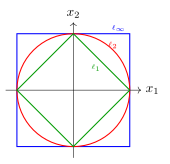
P-lpFor $1 \leq p < \infty$, the $\ell_p$-norm of a vector $\featurevec \in \reals^{\featuredim}$ is defined as $\normgeneric{\featurevec}{p} = \left( \displaystyle \sum_{\featureidx=1}^{\featuredim} |\feature_{\featureidx}|^p \right)^{1/p}$. Its instances include the $\ell_1$-norm and the $\ell_2$-norm (or Euclidean norm); the limit $p \to \infty$ yields the $\ell_\infty$-norm $\normgeneric{\featurevec}{\infty} = \max_{\featureidx = 1, \ldots, \featuredim} |\feature_{\featureidx}|$. Not every norm is induced by an inner product. For an induced norm, expanding $\innerprod{\vu \pm \vv}{\vu \pm \vv}$ yields the parallelogram identity $\normgeneric{\vu + \vv}{}^{2} + \normgeneric{\vu - \vv}{}^{2} = 2 \normgeneric{\vu}{}^{2} + 2 \normgeneric{\vv}{}^{2}$. The $\ell_1$-norm on $\reals^{2}$ violates this identity for $\vu = (1, 0)^{\top}$ and $\vv = (0, 1)^{\top}$: the left-hand side equals $8$, the right-hand side $4$. The unit sphere $\sphere{1} \defeq \big\{ \vu \in \reals^{2} : \normgeneric{\vu}{} = 1 \big\}$ of a norm on $\reals^{2}$ consists of the vectors of unit length; Fig. 1 shows the unit spheres of these three norms.
P-mlML methods use norms to construct loss functions and regularizers. In linear regression, the average squared error loss of a linear hypothesis with model parameters $\weights$ on a training set of size $\samplesize$ is the scaled squared Euclidean norm $(1/\samplesize) \normgeneric{\labelvec - \featuremtx \weights}{2}^{2}$ of the residual $\labelvec - \featuremtx \weights$. Ridge regression adds the penalty term $\regparam \normgeneric{\weights}{2}^{2}$ to this training error, while the least absolute shrinkage and selection operator (Lasso) adds $\regparam \normgeneric{\weights}{1}$ (Tibshirani, 1996).
P-fitThe choice of the norm determines the learned hypothesis by empirical risk minimization (ERM).
Consider the two optimization problems
\begin{equation}
\min_{\weights \in \reals^{\featuredim}}
\normgeneric{\labelvec - \featuremtx \weights}{2}
\quad \text{ and } \quad
\min_{\weights \in \reals^{\featuredim}}
\normgeneric{\labelvec - \featuremtx \weights}{1} \text{,}
\end{equation}
which differ only in the norm of the residual. Squaring the
$\ell_2$-norm does not change the set of minimizers, so
minimizing the $\ell_2$-norm of the
residual is equivalent to minimizing the average
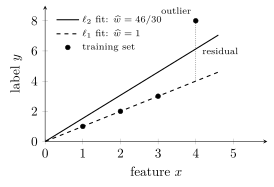
squared error loss. Fig. 2
shows a training set of four data points, one of which
is an outlier, and two linear hypotheses
$\hypothesis(\feature) = \weight \feature$ learned from it.
Minimizing the squared $\ell_2$-norm of the residual yields the
slope $\widehat{\weight} = 46/30$. This solution is pulled
toward the outlier because squaring makes the largest
residual dominate the training error. Minimizing the
$\ell_1$-norm yields $\widehat{\weight} = 1$, which fits the
three remaining data points exactly and leaves a single
large residual at the outlier.
pythondemos/norm.py
@misc{dictml_norm,
  author = {Jung, Alexander},
  editor = {Olioumtsevits, Konstantina and Schnoor, Ekkehard},
  title = {norm},
  howpublished = {Dictionary of Applied Machine Learning (course edition)},
  year = {2026},
  doi = {10.5281/zenodo.21569296},
  note = {ISBN 978-952-64-3013-3, CC BY 4.0, retrieved 2026-09-22},
  url = {https://dictionaryofml.org/terms/norm.html}
}