Dictionary of Applied Machine Learning
Updated on 2026-09-18
Typeset PDF version — the authoritative form of this entry
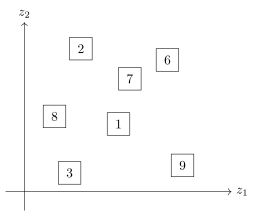
Dimensionality reduction refers to methods that learn a map $\hypothesis: \reals^{\featuredim} \to \reals^{\featuredim'}$ from a large set of raw features to a smaller set of $\featuredim' < \featuredim$ new features. Using fewer features lowers the effective dimension of a model, which reduces the danger of overfitting, and it reduces the computation needed for training. It also enables visualization: two learned features serve as the coordinates of a scatterplot of the data points. Principal component analysis (PCA) is the linear case, with the map chosen to minimize the reconstruction error, and an autoencoder learns a nonlinear map by the same criterion. A random projection reduces the dimension without any training, with distances approximately preserved.
Dimensionality reduction refers to methods that learn a transformation $\hypothesis: \mathbb{R}^{\nrfeatures} \rightarrow \mathbb{R}^{\nrfeatures'}$ of a (typically large) set of raw features $\feature_{1}, \,\ldots, \,\feature_{\nrfeatures}$ into a smaller set of informative features $z_{1}, \,\ldots, \,z_{\nrfeatures'}$. Using a smaller set of features is beneficial in several ways:
@misc{dictml_dimred,
  author = {Jung, Alexander and Olioumtsevits, Konstantina and Schnoor, Ekkehard},
  title = {dimensionality reduction},
  howpublished = {Dictionary of Applied Machine Learning (course edition)},
  year = {2026},
  doi = {10.5281/zenodo.21569296},
  note = {ISBN 978-952-64-3013-3, CC BY 4.0, retrieved 2026-09-19},
  url = {https://dictionaryofml.org/terms/dimred.html}
}