Dictionary of Applied Machine Learning
Updated on 2026-08-29
Typeset PDF version — the authoritative form of this entry
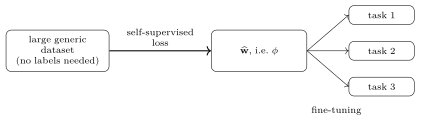
Pretraining is the training of a model on a large, generic dataset to produce model parameters that are reused as the starting point for a later learning task. The loss minimized is typically self-supervised, so no hand-annotated labels are needed and the dataset can be scaled up cheaply. For a large language model (LLM), pretraining minimizes the average next-token prediction loss over a large text corpus. Its output is a set of model parameters $\widehat{\weights}$, equivalently a learned feature transformation, capturing structure shared across many learning tasks. That is what a foundation model provides, and fine-tuning adapts it to one learning task. Generic features are therefore learned once rather than once per task.
Before a deep net is asked to detect tumors in a few hundred annotated scans, it is fitted to millions of ordinary photographs that have nothing to do with tumors. That first step is pretraining: the training of a model on a large, generic dataset to produce model parameters that are reused as the starting point for a later learning task.
The loss minimized during pretraining is typically self-supervised (see self-supervised learning): the supervisory signal is constructed from the input data itself, so no hand-annotated labels are needed and the dataset can be scaled up cheaply. For a large language model (LLM), pretraining minimizes the average next-token prediction loss over a large text corpus (Brown et al., 2020). The photographs in the tumor example come from ImageNet, a corpus of more than three million labeled images at its release (Deng et al., 2009).
The output is a set of model parameters $\widehat{\weights}$, or
equivalently a learned feature transformation $\featuretrafo
\colon \inspace \to \reals^{\featuredim}$, that captures structure
shared across many learning tasks. This is what a
foundation model provides: the same $\featuretrafo$ is reused
across learning tasks by transfer learning, for instance by
appending a small task-specific hypothesis and adapting it
through fine-tuning on a task-specific dataset
(see Fig. 1). Generic features are therefore learned
once, and each later learning task starts from an informative
initialization instead of from scratch.
See also: fine-tuning, self-supervised learning, foundation model, transfer learning, deep net.
@misc{dictml_pretraining,
  author = {Jung, Alexander and Olioumtsevits, Konstantina and Schnoor, Ekkehard},
  title = {pretraining},
  howpublished = {Dictionary of Applied Machine Learning (course edition)},
  year = {2026},
  doi = {10.5281/zenodo.21569296},
  note = {ISBN 978-952-64-3013-3, CC BY 4.0, retrieved 2026-09-19},
  url = {https://dictionaryofml.org/terms/pretraining.html}
}