
accuracy.py, which recomputes what the entry states: the script block by block · open in ColabDictionary of Applied Machine Learning: 107 machine-learning terms, each with a definition, a figure, citations and a Python demo · All terms · Demos · Start here
Updated on 2026-10-21
Readiness 100/100
See also loss classification confusion matrix
Accuracy is the fraction of correct predictions made by a hypothesis on a dataset with a finite label space, equal to one minus the average $0/1$ loss. It is widely used as a single-number metric for classification methods. Accuracy is not suitable as an objective function for training, since the $0/1$ loss is non-smooth and non-convex. Empirical risk minimization (ERM) uses a surrogate loss instead, a convex or smooth upper bound on the $0/1$ loss, and accuracy is reported on a validation set or a test set. On imbalanced data, accuracy alone cannot tell a classifier from a baseline that ignores the features, which calls for other means of evaluation such as the confusion matrix.
accuracy.py, which recomputes what the entry states: the script block by block · open in ColabB-dataAccuracy is the fraction of correct predictions made by a hypothesis $\hypothesis: \featurespace \rightarrow \labelspace$ on a dataset $\dataset = \big\{ \big(\featurevec^{(\sampleidx)}, \truelabel^{(\sampleidx)} \big) \big\}_{\sampleidx=1}^{\samplesize}$ with a finite label space $\labelspace$ (Goodfellow et al., 2016, Sect. 5.1.2; Shalev-Shwartz and Ben-David, 2014, Sect. 2.2). With the $0/1$ loss $\lossfunczo{\datapoint}{\hypothesis}$, which is $1$ for a wrong prediction on the data point $\datapoint$ and $0$ otherwise, accuracy is \begin{align*} \operatorname{acc}(\hypothesis \mid \dataset) & \defeq 1 - \frac{1}{\samplesize} \sum_{\sampleidx=1}^{\samplesize} \lossfunczo{\big(\featurevec^{(\sampleidx)}, \truelabel^{(\sampleidx)}\big)}{\hypothesis} \\ & = \frac{1}{\samplesize} \Big| \Big\{ \sampleidx \in \{1, \,\ldots, \,\samplesize\} : \hypothesis\big(\featurevec^{(\sampleidx)}\big) = \truelabel^{(\sampleidx)} \Big\} \Big| \text{.} \end{align*} Accuracy ranges from $0$ (no prediction is correct) to $1$ (every prediction is correct). Equivalently, accuracy equals one minus the average $0/1$ loss on the dataset. For example, in image classification with the label space $\labelspace = \{\text{cat}, \text{dog}, \text{bird}\}$, the hypothesis assigns each image, represented by its feature vector $\featurevec$, a category $\hypothesis(\featurevec)$. Accuracy is then the fraction of images whose assigned category equals the true label $\truelabel$: $94$ correct assignments among $100$ images give an accuracy of $0.94$.
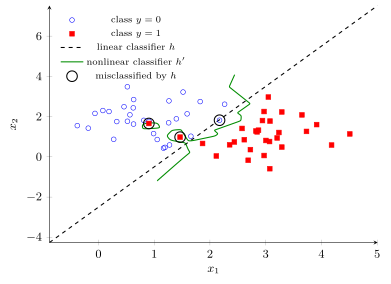
B-linearFig. 1 compares two classifiers on the
same training set $\trainset$ of $60$ data points, the
dataset from which both were learned. The linear classifier $\hypothesis$, whose decision boundary is a line,
misclassifies three data points near that line. The nonlinear classifier
$\hypothesis'$ curves around each of these data points and
classifies them correctly.
pythondemos/accuracy.py
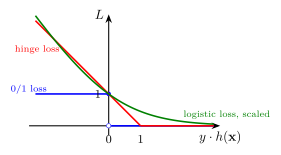
Accuracy could also be used as the objective function for training. However, accuracy is defined via the $0/1$ loss, which is piecewise constant as a function of the model parameters, so accuracy is piecewise constant too: the gradient of accuracy is zero wherever it exists and therefore indicates no direction of improvement. Gradient-based optimization methods cannot maximize accuracy directly. Instead, empirical risk minimization (ERM)-based methods use a surrogate loss that upper bounds the $0/1$ loss and is chosen convex or smooth, so that those methods have a gradient to follow (Shalev-Shwartz and Ben-David, 2014, Sect. 12.3). Two examples for such a surrogate loss are the logistic loss, which is convex and smooth, and the hinge loss, which is convex but non-smooth: not differentiable at margin $1$.
Fig. 2 shows the three loss functions
as functions of the margin, for binary classification with
$\labelspace = \{-1, 1\}$, where a
real-valued hypothesis $\hypothesis$ predicts via the sign
of $\hypothesis(\featurevec)$. Each loss function depends on
the data point only through the margin
$\truelabel \cdot \hypothesis(\featurevec)$, which is how
loss functions for binary classification are compared
(Hastie et al., 2009, Sect. 10.6). The hinge loss
lies above the $0/1$ loss everywhere; the logistic loss
equals $\ln 2$ at margin $0$, so it is the logistic loss
scaled by $1 / \ln 2$ that lies above the $0/1$ loss.
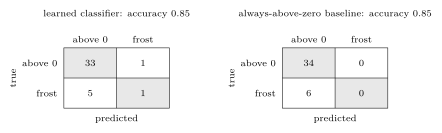
B-overfitThe constant prediction "above zero" (a baseline that
ignores the features) is therefore correct on $34$ of the
$40$ days, an accuracy of $0.85$, and a classifier learned
by logistic regression from the $40$ data points reaches the same
accuracy of $0.85$. Both make $6$ errors and $34$ correct
predictions on the $40$ days, so accuracy cannot tell the
two apart; they differ in where they are right, which calls for
other means of evaluation such as the confusion matrix. The confusion matrices in
Fig. 3 show that the learned classifier
detects one of the six frost days and raises one false alarm,
while the baseline detects none and raises none.
pythondemos/cm.py
See also: $\bf 0/1$ loss, loss, classification, F$_1$ score, confusion matrix, imbalanced data.
@misc{dictml_accuracy,
  author = {Jung, Alexander},
  editor = {Olioumtsevits, Konstantina and Schnoor, Ekkehard},
  title = {accuracy},
  howpublished = {Dictionary of Applied Machine Learning (course edition)},
  year = {2026},
  doi = {10.5281/zenodo.21569296},
  note = {ISBN 978-952-64-3013-3, CC BY 4.0, retrieved 2026-10-27},
  url = {https://dictionaryofml.org/terms/accuracy.html}
}