transferlearning.py, which recomputes what the entry states: the script block by block · open in ColabDictionary of Applied Machine Learning: 114 machine-learning terms, each with a definition, a figure, citations and a Python demo · All terms · Demos · Start here
Updated on 2026-10-29
Readiness 100/100
See also fine-tuning
Transfer learning is the reuse of what was learned on one learning task to solve another learning task. A learning task can be characterized by a probability distribution of data points, and the effectiveness of transfer learning depends on the similarity of the corresponding probability distributions. Task similarity can be encoded as a similarity graph whose edge weights couple the learning tasks at its nodes; transfer learning methods can then be obtained by optimization over this graph.
transferlearning.py, which recomputes what the entry states: the script block by block · open in ColabB-twoThe weather stations Krems an
der Donau and Melk in the Wachau valley each record the minimum
and the maximum temperature of every day. Predicting the maximum
temperature $y$ of a day at one station, the label,
from its minimum temperature $x$, the feature, is a
learning task. Each weather
station defines a separate learning task.
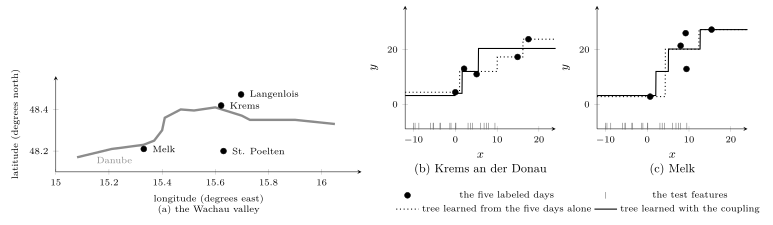
Fig. 1 shows the two tasks side by
side, each with a decision tree of depth two, the
hypothesis learned from a training set of five labeled
days of 2020. A learning task can be characterized by the
probability distribution of its data points: at the two stations those
distributions are similar. Transfer learning uses such similarity. It couples
the learning tasks so that what is learned at one station improves the
predictions at the other, and its effectiveness
depends on how similar the probability distributions of the coupled tasks
are (Pan and Yang, 2010).
pythondemos/transferlearning.py
B-graphThe coupling of two tasks extends to a collection of
learning tasks, one per node $i = 1, \ldots,
n$ of an undirected weighted graph $\mathcal{G}$, the
similarity graph. A weighted edge $\{i,i'\}$
with edge weight $A_{i,i'}$ encodes
the similarity between two learning tasks; a zero weight
leaves them uncoupled. Each node $i$ carries a local model,
a local dataset, and the local hypothesis
$h^{(i)}$ learned from them. Minimizing the
sum of the local training errors plus $\alpha$ times the
generalized total variation (GTV)
\[
\sum_{\{i,i'\} \in \mathcal{E}}
A_{i,i'}
d^{(i,i')} \text{,}
\]
with $d^{(i,i')}$ a measure of the
discrepancy between the local hypotheses
$h^{(i)}$ and $h^{(i')}$, is generalized total variation minimization (GTVMin)
(SarcheshmehPour et al., 2023). The coupling in
Fig. 1 is GTVMin on a
graph with two nodes, with the mean squared disagreement on
the test features $\mathcal{T}$ as the discrepancy measure;
this measure applies to any local model, the
decision trees included. For local models with
model parameters $\mathbf{w}^{(i)}$, the squared
distance $\left\lVert \mathbf{w}^{(i)} -
\mathbf{w}^{(i')} \right\rVert_{2}^{2}$ is a common choice, and the
network Lasso is the variant with the unsquared
distance (Hallac et al., 2015). GTVMin learns all local
hypotheses simultaneously and transfers knowledge between
well-connected learning tasks, as in federated learning (FL).
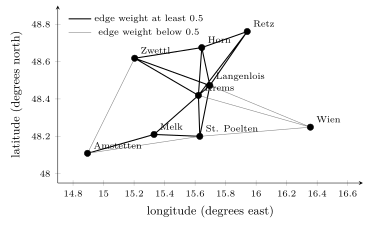
Fig. 2 shows a similarity graph of
nine stations in Lower Austria, with edge weights that fall off
with the distance between stations and are kept for the
nearest neighbors of each. With five labeled days and a
decision tree at every station, GTVMin with the
disagreement on $\mathcal{T}$ lowers the average held-out error
of the nine stations from $57.0$ to $35.9$ and the error at eight
of them; at the ninth, Wien, whose edges are the weakest of the
graph, the coupling raises it slightly.
pythondemos/transferlearning.py
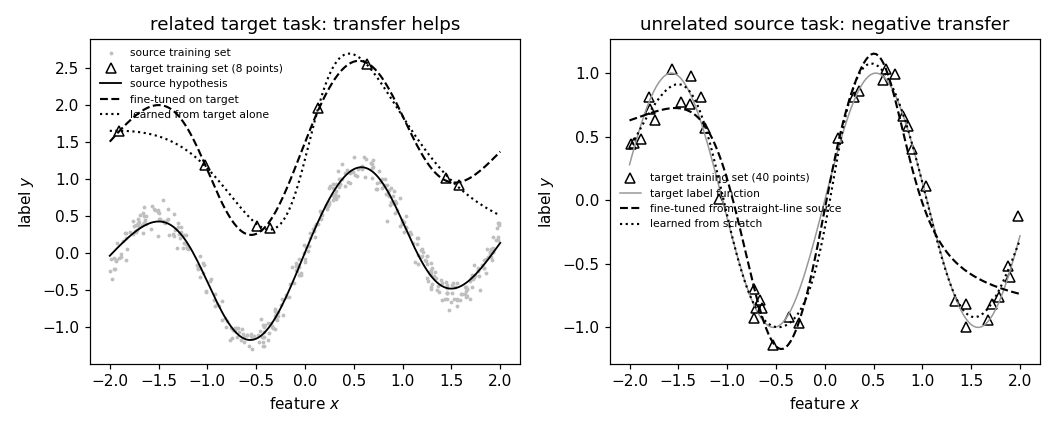
A second form of transfer learning places the similarity between a pretraining task and the new one, instead of between the stations of a similarity graph. It adapts a deep net trained on a large dataset to a small one: the features computed by its early layers are kept (see feature learning) and the remaining model parameters are adapted by fine-tuning. When the features useful for the first task are not useful for the second, the adapted hypothesis can have a larger risk than one trained from scratch, which is called negative transfer (Pan and Yang, 2010). The case in which the learning task stays fixed and only the probability distribution of the feature vectors changes is domain adaptation (Pan and Yang, 2010, Sect. 2.3).
See also: learning task, generalized total variation minimization, generalized total variation, local model, local dataset, edge weight, semi-supervised learning, multitask learning, fine-tuning, domain adaptation, federated learning.
@misc{dictml_transferlearning,
  author = {Jung, Alexander},
  editor = {Olioumtsevits, Konstantina and Schnoor, Ekkehard},
  title = {transfer learning},
  howpublished = {Dictionary of Applied Machine Learning (course edition)},
  year = {2026},
  doi = {10.5281/zenodo.21569296},
  note = {ISBN 978-952-64-3013-3, CC BY 4.0, retrieved 2026-11-03},
  url = {https://dictionaryofml.org/terms/transferlearning.html}
}