pythondemos/trainerr.pyDictionary of Applied Machine Learning
Updated on 2026-09-29
Typeset PDF version — the authoritative form of this entry
Python demo — a script that recomputes what this entry states and prints one line per check
The training error $\trainerror$ of a hypothesis $\learnthypothesis$ is its average loss over the training set, the empirical risk of $\learnthypothesis$ on the data points used for training. For a hypothesis delivered by empirical risk minimization (ERM) it is the smallest empirical risk that any hypothesis of the hypothesis space attains. With the $0/1$ loss it is the fraction of misclassified training data points. Because the same data points selected $\learnthypothesis$, the training error is optimistic: it lies below the risk on average, by a gap that grows with the size of the hypothesis space, so a hypothesis with zero training error may be worthless on new data points. Read beside the validation error, a training error far below it signals overfitting and a large training error signals underfitting.
B-defA straight line is fitted to forty
days of weather recordings to predict each day's maximum daytime
temperature from its morning minimum. On each of the forty days
the line misses the recorded maximum by some amount, between
$0.0$ and $4.0$ degrees. The squared error loss squares each miss, and
the average of the forty squared misses, $2.45$, is the training
error of the line. No other line has a smaller average on these
forty days: the line was chosen to minimize exactly this number.
The numbers are computed by pythondemos/trainerr.py.
The training error $\trainerror$ of a hypothesis $\learnthypothesis$ is its average loss over the training set $\trainset = \{\datapoint^{(\sampleidx)}\}_{\sampleidx=1}^{\samplesize}$, \[ \trainerror = \frac{1}{\samplesize} \sum_{\sampleidx=1}^{\samplesize} \lossfunc{\datapoint^{(\sampleidx)}}{\learnthypothesis} \text{,} \] i.e., the empirical risk of $\learnthypothesis$ on the data points used for training. For a hypothesis delivered by empirical risk minimization (ERM), the training error is the smallest empirical risk that any hypothesis of the hypothesis space attains on $\trainset$, since ERM minimizes precisely this average. With the $0/1$ loss, the training error of a classifier is the fraction of training data points it misclassifies; with the logistic loss, it is the negative average log-likelihood of the training labels (Hastie et al., 2009, Sect. 7.2).
The training error is computed on the same data points that selected $\learnthypothesis$, and this is what limits its value as a measure of quality. The goal of a machine learning (ML) method is a small loss on data points it has not seen, formalized as a small risk for data points that are realizations of independent and identically distributed (i.i.d.) random variables (RVs). Because $\learnthypothesis$ was picked to make the average on $\trainset$ small, the training error is optimistic: on average over the draw of the training set it lies below the risk, and the more the hypothesis space offers to choose from, the larger the gap (Hastie et al., 2009, Sect. 7.4). A hypothesis with zero training error may therefore be worthless on new data points. The validation error, computed on data points that did not enter the training, has no such optimism and estimates the risk; the difference between the two is the generalization gap.
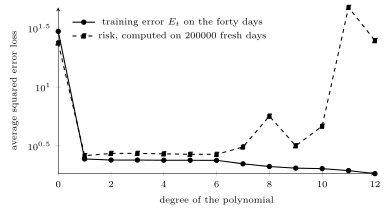
B-degreeFig. 1 shows both errors for polynomials of
degree $0$ to $12$ fitted by ERM to the forty days. The
hypothesis spaces are nested, a polynomial of degree $d$ being one
of degree $d+1$ with a zero coefficient, so the training error
never increases with the degree: it falls from $29.7$ for the
constant to $2.45$ for the line and $1.84$ for degree $12$. The
risk, computed on $200000$ fresh days, is smallest for the
line, $2.61$, and reaches $24.8$ at degree $12$, where the
polynomial follows the noise of the forty recordings.
pythondemos/trainerr.py
See also: training set, empirical risk, empirical risk minimization, loss, validation error, risk, generalization gap, overfitting, underfitting, hypothesis.
@misc{dictml_trainerr,
  author = {Jung, Alexander},
  editor = {Olioumtsevits, Konstantina and Schnoor, Ekkehard},
  title = {training error},
  howpublished = {Dictionary of Applied Machine Learning (course edition)},
  year = {2026},
  doi = {10.5281/zenodo.21569296},
  note = {ISBN 978-952-64-3013-3, CC BY 4.0, retrieved 2026-09-29},
  url = {https://dictionaryofml.org/terms/trainerr.html}
}