Dictionary of Applied Machine Learning
Updated on 2026-09-18
Typeset PDF version — the authoritative form of this entry
Python demo — a script that recomputes what this entry states and prints one line per check
Interpretable machine learning (interpretable ML) refers to machine learning (ML) methods whose hypothesis space contains only hypotheses that a human user can comprehend directly, such as sparse linear models or shallow decision trees. Such methods let a user see how a prediction changes when the features of a data point change, and how the predictions change when a different training set is used. An interpretable hypothesis is its own explanation; post hoc explanations of the predictions of an opaque learned hypothesis can instead be unfaithful. Restricting the hypothesis space to interpretable hypotheses also acts as a form of regularization. A penalty term can pick a comprehensible hypothesis out of a hypothesis space that mostly holds others: least absolute shrinkage and selection operator (Lasso) drives most weights of a linear model to zero, leaving a hypothesis with few nonzero weights, and explainable empirical risk minimization (EERM) penalizes deviations from the predictions one user supplies during training.
Interpretable ML refers to machine learning (ML) methods whose hypothesis space contains only hypotheses that a human user can comprehend directly (see interpretability). Such methods let a user follow both what a learned hypothesis does to its input and how training produced it. Ultimately, an interpretable ML method allows the user to understand how a prediction changes when the features of a data point change, and how the predictions change when a different training set is used. Thus, interpretable ML methods require suitable choices for the hypothesis space and the training algorithm.
B-treeExamples of interpretable ML include empirical risk minimization (ERM) with
linear models that combine a small number of meaningful features, shallow decision trees whose
predictions follow from a few explicit tests, generalized additive models (GAMs), and lists of
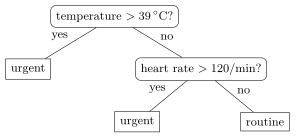
decision rules (Molnar, 2025). Fig. 1
depicts a decision tree for medical triage in a hospital. This system
involves two tests of vital signs, allowing the staff to
trace every prediction by reading the tree.
B-effectAn interpretable ML method also makes the effect of training set changes traceable. This dependence is studied under stability, which formalizes an ML method as a map from a training set to a learned hypothesis. For linear regression, this map is available in closed form through the normal equations, so the user can compute how a perturbed label in the training set shifts the predictions (see linear regression).
An interpretable hypothesis is its own explanation: no separate explanation is constructed for it. The explanation delivered with a prediction can then be a description of the learned hypothesis itself: the weights of a linear model that combines few features, or the flow chart of a shallow decision tree as in Fig. 1. A hypothesis space containing only such hypotheses is called intrinsically interpretable (Molnar, 2025). This contrasts with explainable artificial intelligence (XAI), which constructs post hoc explanations for the predictions of a possibly opaque learned hypothesis. For high-stakes applications, such as the medical triage of Fig. 1, using an interpretable model can be preferable to explaining an opaque model, since post hoc explanations can be unfaithful to the hypothesis they explain (Rudin, 2019).
B-eermAn interpretable learned hypothesis can also be obtained
without restricting the hypothesis space beforehand. A
penalty term added to the objective function of ERM de-incentivizes
the hypotheses a user cannot follow, so training picks
a comprehensible one out of a hypothesis space that mostly holds the
others. Least absolute shrinkage and selection operator (Lasso) does this for linear models, which are no
more comprehensible than a deep net once they weigh hundreds of
features. Lasso uses the $\ell_{1}$-norm
$\normgeneric{\weights}{1}$ of the weights $\weights$ as the
penalty term, which drives most weights to exactly zero
(Hastie et al., 2009, Sect. 3.4). The learned
hypothesis is then a weighted sum of a few features, so
a user can name the features the prediction rests on
and how much each one moves it.
Explainable empirical risk minimization (EERM) extends this idea to the training of an arbitrary
model. Its penalty term is built from the
predictions that one specific user supplies for the
data points of the training set (see EERM). It
therefore delivers explainability to that user rather
than interpretability, and it leaves the hypothesis space
as it is. The user predictions need not be
elicited one data point at a time. They might be obtained as
the predictions of a simpler proxy model that the user
considers interpretable, so that the penalty term measures the
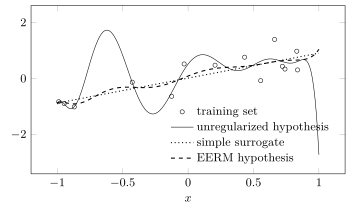
deviation from that proxy. In
Fig. 2, the user
predictions are obtained from a simple linear model
fitted to the training set.
pythondemos/interpretableml.py
@misc{dictml_interpretableml,
  author = {Jung, Alexander},
  editor = {Olioumtsevits, Konstantina and Schnoor, Ekkehard},
  title = {interpretable machine learning},
  howpublished = {Dictionary of Applied Machine Learning (course edition)},
  year = {2026},
  doi = {10.5281/zenodo.21569296},
  note = {ISBN 978-952-64-3013-3, CC BY 4.0, retrieved 2026-09-21},
  url = {https://dictionaryofml.org/terms/interpretableml.html}
}