Dictionary of Applied Machine Learning
Updated on 2026-10-08
See also membership inference attack
A trusted execution environment (TEE) is a part of a computing system that runs code and holds data in isolation from the rest of the system. Neither the operating system nor the operator of the hardware can read or alter them, and the TEE can prove to another party which code it runs. Processor features such as Arm TrustZone and Intel SGX provide a TEE on an ordinary chip; a sealed, shielded embedded device without network connection is the physical extreme. In machine learning (ML), a TEE protects three assets: the feature vectors handed to a learned hypothesis, the model parameters of that hypothesis, and the integrity of the computed prediction. It hides nothing about what the prediction reveals, which is the part that differential privacy (DP) addresses, and it protects against physical side channels only with hardware countermeasures. Compared with fully homomorphic encryption (FHE), a TEE runs at near-native speed but rests on trust in the chip vendor rather than on a mathematical proof.
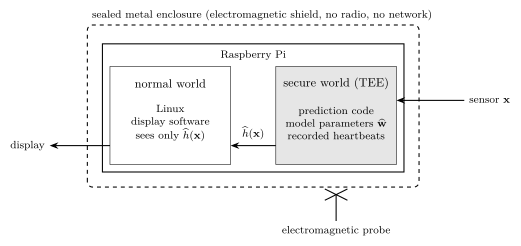
Consider a Raspberry Pi in a
clinic that reads the signal of an electrocardiograph and computes, from the
feature vector $\featurevec$ of each heartbeat, the prediction
$\learnthypothesis(\featurevec)$ of a learned hypothesis that flags an
arrhythmia. The board sits in a sealed metal box with no network cable and no
radio. The only inputs are the sensor cable and the power cable, and the only
output is a display. The model parameters $\widehat{\weights}$ of
$\learnthypothesis$ and the recorded heartbeats never leave the box. A TEE is
the part of a computing system that provides this kind of protection: code and
data inside it cannot be read or altered from outside, and a party outside can
verify which code runs inside (Sabt et al., 2015). The sealed box is the physical
extreme of a TEE. Most TEEs are instead a mode of an ordinary processor:
Arm TrustZone splits the processor of the Raspberry Pi into a normal world,
which runs Linux and the display software, and a secure world, which runs the
prediction code and holds $\widehat{\weights}$ and the heartbeats; the
normal world cannot read the memory of the secure world even with root
privileges (Pinto and Santos, 2019). Intel SGX provides the same isolation for
an enclave inside a process on a server (Costan and Devadas, 2016), and remote
attestation lets a client verify a signed digest of the enclave's code before
it sends any data. Fig. 1 shows the Raspberry Pi and what
each part can see.
Two uses of TEEs beyond the sealed box are prediction in the cloud and federated learning (FL). A hospital that rents a server can require an SGX enclave, verify by attestation that it runs the agreed prediction code, and send its feature vectors encrypted to the enclave's key, so that the cloud provider never sees them (Ohrimenko et al., 2016). In FL, an enclave on the server implements secure aggregation: the clients encrypt their model parameters updates to the enclave, which decrypts and sums them, and the server operator sees only the sum; the TrustZone secure world of each phone protects the local update in turn (Mo et al., 2021).
A TEE, fully homomorphic encryption (FHE) and DP protect against different parties by different means. FHE hides the data from the computing party by mathematics, at a cost of orders of magnitude in time and memory, and needs no trust in the hardware. A TEE hides the data by hardware isolation at near-native speed, and rests on trust in the chip vendor and in the absence of side channels. DP bounds what the prediction reveals about any single data point and is combined with either.
Synonyms: secure enclave.
See also: fully homomorphic encryption, secure aggregation, differential privacy, privacy protection, privacy attack, membership inference attack, attack, federated learning, edge device, cloud computing, machine learning system, trustworthy artificial intelligence.
@misc{dictml_tee,
  author = {Jung, Alexander},
  editor = {Olioumtsevits, Konstantina and Schnoor, Ekkehard},
  title = {trusted execution environment (TEE)},
  howpublished = {Dictionary of Applied Machine Learning (course edition)},
  year = {2026},
  doi = {10.5281/zenodo.21569296},
  note = {ISBN 978-952-64-3013-3, CC BY 4.0, retrieved 2026-10-08},
  url = {https://dictionaryofml.org/terms/tee.html}
}