Dictionary of Applied Machine Learning
Updated on 2026-09-30
Typeset PDF version — the authoritative form of this entry
A membership inference attack decides whether a given data point belonged to the training set of a published hypothesis. The signal it uses is memorization: empirical risk minimization (ERM) drives the loss down on the training set and nowhere else, so a small loss at a candidate data point is evidence of membership. An adversary queries the hypothesis and compares the loss of its prediction against a threshold. What the attack can learn is therefore bounded by the gap between training error and validation error, which makes it a privacy cost of overfitting rather than a separate failure. Differential privacy (DP) bounds the leak by construction, at a cost in accuracy.
A clinic trains a hypothesis on the records of a few hundred patients, which are personal data, and publishes it. A patient asks whether their own record was among them. A membership inference attack is the privacy attack that answers such a question: an adversary with access to $\learnthypothesis$ decides whether a given data point belonged to the training set (Shokri et al., 2017).
The signal is memorization. Empirical risk minimization (ERM) drives the loss down
on the training set and nowhere else, so a small loss at a
candidate data point is evidence of membership. The adversary
queries $\learnthypothesis$ at the feature vector and compares
the loss of its prediction against a threshold.
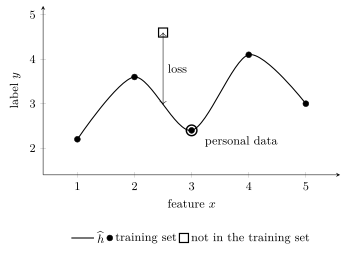
Fig. 1 shows why the attack
works: a hypothesis flexible enough to pass through five
data points reproduces each of their labels exactly,
while a data point it never saw is missed by a visible
margin.
See also: attack, privacy attack, personal data, differential privacy, overfitting, training error, validation error, training set, empirical risk minimization.
@misc{dictml_membershipinferenceattack,
  author = {Jung, Alexander},
  editor = {Olioumtsevits, Konstantina and Schnoor, Ekkehard},
  title = {membership inference attack},
  howpublished = {Dictionary of Applied Machine Learning (course edition)},
  year = {2026},
  doi = {10.5281/zenodo.21569296},
  note = {ISBN 978-952-64-3013-3, CC BY 4.0, retrieved 2026-09-30},
  url = {https://dictionaryofml.org/terms/membershipinferenceattack.html}
}