Dictionary of Applied Machine Learning
Updated on 2026-10-12
See also random variable probability distribution independent and identically distributed
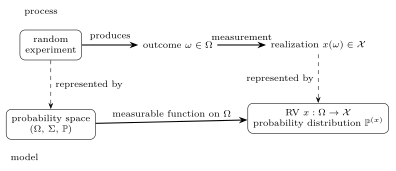
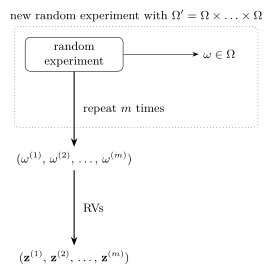
A random experiment is a physical or computational process that produces an outcome $\outcome$ from a known set $\samplespace$ of possibilities, the sample space, without the outcome being known in advance. Probability theory represents the process by a probability space $\probspace$, where the $\sigma$-algebra $\sigmaalgebra$ collects the events and the probability measure $\prob{\cdot}$ assigns each event a probability; this representation is a probabilistic model of the process, not a property of it. A measurement of the outcome is represented by a random variable (RV), a measurable function $\feature : \samplespace \to \featurespace$, and the measured value $\feature(\outcome)$ is a realization. Repeating the experiment $\samplesize$ times is itself a random experiment on the product sample space, and the measurements of the runs are modeled as independent and identically distributed (i.i.d.) RVs. In machine learning (ML), the collection of a training set, the draw of a subset of it by stochastic gradient descent (SGD), and the noise added for differential privacy (DP) are random experiments.
Rolling a die, reading the maximum temperature of a day at the weather station Krems an der Donau, or drawing a handful of data points from a training set for one iteration of stochastic gradient descent (SGD): each of these is a random experiment. Its outcome is not known before the process is carried out, while the set of possible outcomes is. Formally, a random experiment is a physical or computational process that produces an outcome $\outcome$ from a set $\samplespace$ of possibilities, the sample space of the experiment (Bertsekas and Tsitsiklis, 2008, Sect. 1.2; Billingsley, 1986). Its defining characteristic is that the outcome is uncertain, and a key conceptual property is that it can be repeated under identical conditions.
Probability theory does not study the process itself but a mathematical representation of it, a probability space $\probspace$ (Bertsekas and Tsitsiklis, 2008, Sect. 1.2; Billingsley, 1986). The sample space $\samplespace$ collects the possible outcomes. The $\sigma$-algebra $\sigmaalgebra$ collects the events, those subsets $\genericevent \subseteq \samplespace$ to which a probability is assigned. The probability measure $\prob{\cdot}$ assigns to each event $\genericevent \in \sigmaalgebra$ a number $\prob{\genericevent} \in [0,1]$ such that $\prob{\samplespace} = 1$ and the probability of a countable union of pairwise disjoint events is the sum of their probabilities. Choosing $\samplespace$, $\sigmaalgebra$ and $\prob{\cdot}$ is a modeling step: the probability measure is a property of the probabilistic model, not of the process. For a die, the sample space is $\{1, \ldots, 6\}$ and the uniform probability measure is the model of a fair die; whether a given die is fair is a question about the process, answered by the relative frequencies of its outcomes in many rolls.
What is observed of an outcome is a measurement, a
function $\feature : \samplespace \to \featurespace$ of the
outcome. Such a measurable function is a random variable (RV),
and the value $\feature(\outcome)$ it takes for the actual
outcome $\outcome$ is a realization of it
(Billingsley, 1986; Gray, 2009). The
temperature read at 13:00 is an RV on the weather of a day, and
the number read on one day is a realization. The
probability measure on $\samplespace$ induces the probability distribution of the
RV, $\probdist^{(\feature)}(\mathcal{B}) = \prob{\feature \in
\mathcal{B}}$ for every measurable set $\mathcal{B} \subseteq
\featurespace$. Machine learning (ML) methods work with the RVs and their
probability distributions; the sample space behind them rarely needs to
be written down. Fig. 1 depicts
the two layers, the process and its mathematical representation.
See also: outcome, sample space, event, random variable, realization, probability, probability space, probability measure, probability distribution, probabilistic model, independent and identically distributed, law of large numbers, central limit theorem.
@misc{dictml_randomexperiment,
  author = {Jung, Alexander},
  editor = {Olioumtsevits, Konstantina and Schnoor, Ekkehard},
  title = {random experiment},
  howpublished = {Dictionary of Applied Machine Learning (course edition)},
  year = {2026},
  doi = {10.5281/zenodo.21569296},
  note = {ISBN 978-952-64-3013-3, CC BY 4.0, retrieved 2026-10-12},
  url = {https://dictionaryofml.org/terms/randomexperiment.html}
}