Dictionary of Applied Machine Learning
Updated on 2026-09-30
Typeset PDF version — the authoritative form of this entry
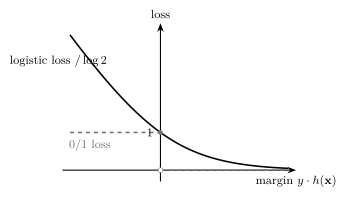
The logistic loss is a convex and smooth surrogate for the $0/1$ loss in binary classification, defined for a label $\truelabel \in \{-1, +1\}$ and a real-valued hypothesis $\hypothesis$ as a decreasing function of the margin $\truelabel \cdot \hypothesis(\featurevec)$. Like the hinge loss, it uses a data point only through that margin. Rescaled by its value at margin zero it is an upper bound on the $0/1$ loss, with equality there, so a small logistic loss forces a small $0/1$ loss. Unlike the hinge loss it is differentiable everywhere, which suits it to gradient-based optimization methods such as gradient descent (GD). Running empirical risk minimization (ERM) with a linear hypothesis and the logistic loss gives logistic regression.
A spam filter either flags an email or does not, so its mistakes are counted rather than measured: the $0/1$ loss charges $1$ for every wrong answer. That count is flat almost everywhere as a function of the model parameters, so it gives gradient descent (GD) no direction to move in. The logistic loss replaces it by a convex and smooth surrogate that lies above it.
Consider a binary classification problem with label
$\truelabel \in \{-1, +1\}$ and a real-valued hypothesis
$\hypothesis: \featurespace \rightarrow \reals$. On a
data point $(\featurevec, \truelabel)$ the logistic loss
is (Bishop, 2006)
\begin{equation}
\label{equ_log_loss_gls_dict}
\lossfunc{(\featurevec, \truelabel)}{\hypothesis}
\defeq \log\big(1 + \exp(-\truelabel \cdot
\hypothesis(\featurevec))\big) \text{.}
\end{equation}
Like the hinge loss, the logistic loss depends on
the margin $\truelabel \cdot \hypothesis(\featurevec)$
(see $0/1$ loss), and after division by $\log 2$ it is
a convex upper bound on the $0/1$ loss, with
equality at margin $0$ (see Fig. 1).
Synonyms: log loss, binary cross-entropy loss.
See also: $\bf 0/1$ loss, hinge loss, classifier, logistic regression, gradient descent, convex, binary classification.
@misc{dictml_logloss,
  author = {Jung, Alexander},
  editor = {Olioumtsevits, Konstantina and Schnoor, Ekkehard},
  title = {logistic loss},
  howpublished = {Dictionary of Applied Machine Learning (course edition)},
  year = {2026},
  doi = {10.5281/zenodo.21569296},
  note = {ISBN 978-952-64-3013-3, CC BY 4.0, retrieved 2026-09-30},
  url = {https://dictionaryofml.org/terms/logloss.html}
}