Dictionary of Applied Machine Learning
Updated on 2026-09-18
Typeset PDF version — the authoritative form of this entry
Python demo — a script that recomputes what this entry states and prints one line per check
A standard Gaussian random variable (Gaussian RV) is a real-valued random variable (RV) with probability density function (pdf) proportional to $\exp(-\eta^{2}/2)$. A general Gaussian RV with mean $\mu$ and variance $\sigma^{2}$ is obtained by scaling and shifting a standard Gaussian RV. A Gaussian random vector is an affine transformation of independent standard Gaussian RVs. Gaussian RVs arise naturally as limits of averages of many independent RVs through the central limit theorem (CLT). Among all random vectors with a given covariance matrix, the Gaussian random vector maximizes the differential entropy.
P-stdA standard Gaussian random variable (RV) is a
real-valued RV $\feature$ with a probability density function (pdf) (Bertsekas and Tsitsiklis, 2008; Gray, 2009; Papoulis and Pillai, 2002)
\begin{equation}
\nonumber
\pdf{\feature}{\eta} = \frac{1}{\sqrt{2\pi}} \exp\,(-\eta^2/2) \text{.}
\end{equation}
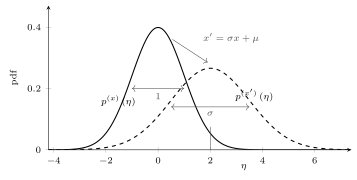
Given a standard Gaussian RV $\feature$, a general Gaussian
RV $\feature'$ with mean $\mu$ and variance $\sigma^2$ can be constructed via
$\feature' \defeq \sigma \feature + \mu$.
The probability distribution of a Gaussian RV is referred to as the normal distribution,
denoted by $\mvnormal{\mu}{\sigma^{2}}$. Its pdf is
\[
\pdf{\feature'}{\eta} = \frac{1}{\sqrt{2\pi\sigma^{2}}}
\exp\Big( -\frac{(\eta-\mu)^{2}}{2\sigma^{2}} \Big) \text{.}
\]
Two methods generate Gaussian
RVs. For exact generation, let $U$ be uniformly distributed on
$(0,1)$ and let $\Phi$ be the cumulative distribution function (cdf) of a standard Gaussian RV.
Then $\feature' \defeq \mu + \sigma\Phi^{-1}(U)$ has distribution
$\mvnormal{\mu}{\sigma^{2}}$. For approximate generation, if
$\feature^{(i)}$ are independent and identically distributed (i.i.d.) RVs with mean $0$ and
finite, nonzero variance $\tau^{2}$, then
\[
\frac{1}{\tau\sqrt{n}}\sum_{i=1}^{n}\feature^{(i)}
\]
converges in distribution to a standard Gaussian RV as $n$ increases.
Thus, the central limit theorem (CLT) makes a Gaussian approximation appropriate for averages
of many independent contributions, although a finite sum need not be Gaussian
(Ross, 2014).
The two parameters act separately on the pdf, as shown in
Fig. 1. Adding $\mu$ shifts the pdf along the
horizontal axis without changing its shape. For $\sigma>0$, multiplying
the RV by $\sigma$ stretches the pdf horizontally by a factor
of $\sigma$ and lowers its peak by the same factor, so its area remains $1$.
P-processA Gaussian random vector $\featurevec=\big(\feature_{1},\,\ldots,\,\feature_{\featuredim}\big)^{\top}$ can be interpreted as a stochastic process indexed by the finite set $\{1,\,\ldots,\,\featuredim\}$. More generally, a Gaussian process (GP) is a stochastic process over an index set $\indexset$ whose restriction to every finite subset of $\indexset$ is a Gaussian random vector (Rasmussen and Williams, 2006).
Gaussian RVs are widely used probabilistic models in the statistical analysis of machine learning (ML) methods, including regression with additive Gaussian measurement noise. For example, a regression method can use $\truelabel = \weights^{\top}\featurevec + \epsilon$ with $\epsilon \sim \mvnormal{0}{\sigma^{2}}$. Maximizing the resulting likelihood is equivalent to minimizing squared loss, connecting the Gaussian noise assumption to empirical risk minimization (ERM).
P-maxentAmong all random vectors with a given covariance matrix $\covmtxgeneric$, the random vector $\featurevec \sim \mvnormal{\meanvecgeneric}{\covmtxgeneric}$ maximizes differential entropy (Cover and Thomas, 2006, Th. 8.6.5). It is therefore the least-committal choice of probability distribution when only the first two moments are fixed.
See also: multivariate normal distribution, Gaussian process, probabilistic model, central limit theorem, differential entropy.
@misc{dictml_gaussrv,
  author = {Jung, Alexander},
  editor = {Olioumtsevits, Konstantina and Schnoor, Ekkehard},
  title = {Gaussian random variable},
  howpublished = {Dictionary of Applied Machine Learning (course edition)},
  year = {2026},
  doi = {10.5281/zenodo.21569296},
  note = {ISBN 978-952-64-3013-3, CC BY 4.0, retrieved 2026-09-21},
  url = {https://dictionaryofml.org/terms/gaussrv.html}
}