Dictionary of Applied Machine Learning
Updated on 2026-09-01
Typeset PDF version — the authoritative form of this entry
Python demo — a script that recomputes what this entry states and prints one line per check
Attention is a mechanism that models the dependencies between the tokens that make up a data point, such as the words in a sentence or the pixel patches of an image. The idea is to represent the relationship between two tokens by a parameterized weight function whose model parameters are learned from a training set. An attention head then computes a new vector representation for each token as a weighted combination of the value vectors of all tokens. Like the weight function, the value vectors are learned. An attention head acts as a differentiable associative memory: a token uses its query vector to retrieve, through the key vectors of the other tokens, the values most relevant to it. Attention heads capture long-range dependencies between tokens regardless of their positions within a data point, and they are a core component of modern large language models (LLMs).
Some machine learning (ML) applications involve data points composed of smaller units, referred to as tokens. For example, a sentence consists of words, an image of pixel patches, and a network of nodes. In general, the tokens that constitute a single data point are not independent of one another. Instead, each token of a data point depends on specific other tokens of the same data point. The attention mechanism is a building block of artificial neural networks (ANNs) that captures long-range dependencies between tokens regardless of their positions within a data point.
Probabilistic models provide a principled way of representing and analyzing such dependencies (Blei et al., 2003). Attention mechanisms instead represent these dependencies directly, without specifying a probability distribution over the tokens. They represent the relationship between two tokens $\nodeidx$ and $\nodeidx'$ by an attention weight $f^{(\weights)}(\nodeidx,\nodeidx')$, a parameterized function whose model parameters $\weights$ are learned. The attention weight measures how strongly token $\nodeidx$ attends to token $\nodeidx'$. Practical attention mechanisms differ in their choice of the function $f^{(\weights)}(\nodeidx,\nodeidx')$ and in the empirical risk minimization (ERM) variant used to learn $\weights$. The most widely used choice, described below, is scaled dot-product attention (Vaswani et al., 2017).
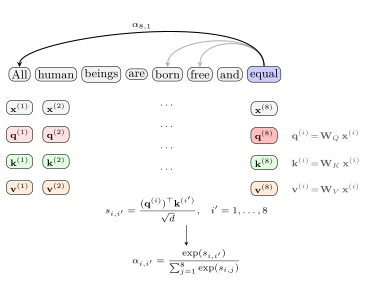
B-modelScaled dot-product attention derives three vectors from the embedding vector $\featurevec^{(\nodeidx)} \in \reals^{\featuredim}$ of each token $\nodeidx$ via learned matrices: a query (vector) $\vq^{(\nodeidx)} = \mW_Q\, \featurevec^{(\nodeidx)}$, a key (vector) $\vk^{(\nodeidx)} = \mW_K\, \featurevec^{(\nodeidx)}$, and a value (vector) $\vv^{(\nodeidx)} = \mW_V\, \featurevec^{(\nodeidx)}$, where \[\mW_Q, \mW_K, \mW_V \in \reals^{\featuredim \times \featuredim}\] are model parameters learned during training. Intuitively, the query determines what a token "asks for," the key of a token determines what it "advertises," and the value carries the information that is aggregated (cf. Bishop and Bishop, 2024; Elhage et al., 2021).
B-displayThe output of the attention mechanism for token $\nodeidx$
is a weighted sum of the values of all tokens,
\[
\vz^{(\nodeidx)}
= \sum_{\nodeidx'=1}^{\contextlen} \alpha_{\nodeidx,\nodeidx'}\,
\vv^{(\nodeidx')} \text{.}
\]
Here, $\contextlen$ denotes the number of tokens of the
data point, and the coefficient $\alpha_{\nodeidx,\nodeidx'}$ is
the attention weight, i.e., the scaled dot-product form of
$f^{(\weights)}(\nodeidx,\nodeidx')$. The attention weights are
computed from the queries and keys in two steps.
First, the attention score between tokens $\nodeidx$ and $\nodeidx'$ is
\[
s_{\nodeidx,\nodeidx'}
= \frac{\big(\vq^{(\nodeidx)}\big)^{\top} \vk^{(\nodeidx')}}
{\sqrt{\featuredim}} \text{.}
\]
The inner product (also called dot product)
$\big(\vq^{(\nodeidx)}\big)^{\top} \vk^{(\nodeidx')}$ measures how well
the key of token $\nodeidx'$ matches the query of token
$\nodeidx$.
Second, the attention weight $\alpha_{\nodeidx,\nodeidx'}$ follows by
applying the softmax function to the scores $s_{\nodeidx,\nodeidx'}$
across all tokens $\nodeidx'$:
\[
\alpha_{\nodeidx,\nodeidx'}
= \frac{\exp(s_{\nodeidx,\nodeidx'})}
{\sum_{j=1}^{\contextlen} \exp(s_{\nodeidx,j})} \text{.}
\]
The softmax function normalizes the scores: the attention
weights $\alpha_{\nodeidx,\nodeidx'}$ are nonnegative and sum to one
across $\nodeidx' = 1, \ldots, \contextlen$, forming a probability distribution
over the tokens. Dividing the inner product by $\sqrt{\featuredim}$
in the attention score counteracts its growth with the dimension
$\featuredim $ (Vaswani et al., 2017, Sect. 3.2.1). Indeed,
$\big(\vq^{(\nodeidx)}\big)^{\top} \vk^{(\nodeidx')}$ is a
sum of $\featuredim $ terms, so without the scaling, a large $\featuredim $ would push the
softmax function into a region where its gradients nearly vanish.
Fig. 1 illustrates scaled dot-product attention
for an eight-token sentence.
B-csvAttention can be read as a differentiable associative memory, i.e., a content-addressable store (Ramsauer et al., 2021): the keys $\vk^{(\nodeidx')}$ act as addresses, the values $\vv^{(\nodeidx')}$ as stored contents, and a token $\nodeidx$ searches the other tokens with its query $\vq^{(\nodeidx)}$. The inner product $\big(\vq^{(\nodeidx)}\big)^{\top}\vk^{(\nodeidx')}$ measures how well the address $\nodeidx'$ matches the query, the softmax function turns the match scores into retrieval weights, and the output $\vz^{(\nodeidx)}$ is the retrieved content.
Because $\vq^{(\nodeidx)}$ and $\vk^{(\nodeidx')}$ are obtained from the different matrices $\mW_Q$ and $\mW_K$, the attention weights are directed: in general, $\alpha_{\nodeidx,\nodeidx'} \neq \alpha_{\nodeidx',\nodeidx}$, so that token $\nodeidx$ attending strongly to token $\nodeidx'$ does not imply the reverse. Directionality arises because asking for information (the query) and advertising it (the key) are distinct roles.
A classical dictionary data structure or hash table returns the single value stored at an exactly matching address (Cormen et al., 2022, Ch. 11). Attention instead returns a weighted average. Moreover, its output $\vz^{(\nodeidx)}$ is a differentiable function of the matrices $\mW_Q$, $\mW_K$, and $\mW_V$. In particular, the queries, keys, and values can themselves be learned via gradient-based methods for solving ERM. The same retrieval principle, softened into a weighted average, underlies $k$-nearest neighbors ($k$-NN) methods. It also guides efficient implementations: locality-sensitive hashing restricts each query to nearby keys, reducing the cost of one attention head from $\contextlen^{2}$ query–key comparisons to approximately $\contextlen \log \contextlen$, with $\contextlen$ again the number of tokens (Kitaev et al., 2020).
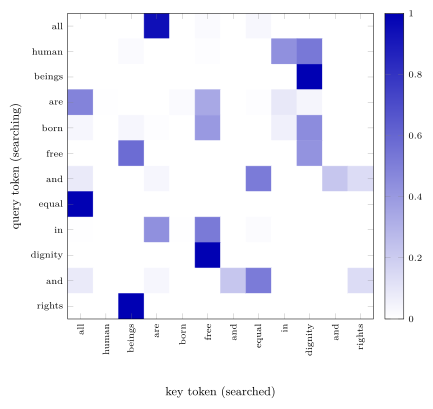
B-previewFig. 2 visualizes the attention weights
$\alpha_{\nodeidx,\nodeidx'}$ that a single head learns on sentences
from the Universal Declaration of Human Rights (Assembly, 1948).
Trained to reconstruct each masked token from the others, the
head gives many query tokens a weight concentrated on a few keys
rather than spread uniformly, illustrating the associative-memory
reading on this small corpus. The heat map also shows the directed
nature of the weights discussed above: the query token
"rights" places its full weight on the key token "beings"
($\alpha_{12,3} = 1.0$), while the query token "beings"
places no weight on the key token "rights"
($\alpha_{3,12} = 0.0$).
pythondemos/attention.py
See also: token, embedding, transformer, softmax function, sequence, natural language processing, large language model, model parameter, empirical risk minimization, $k$-nearest neighbors, differentiable.
@misc{dictml_attention,
  author = {Jung, Alexander},
  editor = {Olioumtsevits, Konstantina and Schnoor, Ekkehard},
  title = {attention},
  howpublished = {Dictionary of Applied Machine Learning (course edition)},
  year = {2026},
  doi = {10.5281/zenodo.21569296},
  note = {ISBN 978-952-64-3013-3, CC BY 4.0, retrieved 2026-09-21},
  url = {https://dictionaryofml.org/terms/attention.html}
}