Dictionary of Applied Machine Learning
Updated on 2026-09-19
Typeset PDF version — the authoritative form of this entry
Python demo — a script that recomputes what this entry states and prints one line per check
An eigenvalue of a square matrix $\mA$ is a number $\eigvalgen$ for which some nonzero vector $\vx$ satisfies $\mA\vx = \eigvalgen\vx$. Such a vector is an eigenvector of $\mA$. Multiplying an eigenvector by the matrix rescales it without moving it off the line it spans. The eigenvalues of a diagonalizable matrix form the diagonal factor of its eigenvalue decomposition (EVD). An iterative method that applies an affine update, such as gradient descent (GD) for linear regression, converges to the unique fixed point of the update, for every initialization, exactly when each eigenvalue of the update matrix has magnitude less than one. The second-smallest eigenvalue of the Laplacian matrix of an undirected graph measures how well the graph is connected and underlies spectral clustering.
P-convA square matrix $\mA$ represents a
linear map from $\reals^{\featuredim}$ to $\reals^{\featuredim}$;
the image of a vector $\vx$ under this map is the product
$\mA\vx$. Multiplying a vector by a square
matrix normally moves it off the line it spans. Some nonzero
vectors are exceptions: each stays on the line it spans and
is only rescaled. The factor by which such a vector is
rescaled is an eigenvalue. Formally, a number
$\eigvalgen \in \reals$ is an eigenvalue of a square matrix
$\mA \in \reals^{\featuredim \times \featuredim}$, one with
$\featuredim$ rows and $\featuredim$ columns, if
$\mA \vx = \eigvalgen \vx$ for some nonzero vector
$\vx \in \reals^{\featuredim}$; such a vector is an
eigenvector of $\mA$. The product $\mA\vx$ is the image of
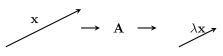
$\vx$ under $\mA$; for an eigenvector it stays on the line
$\vx$ spans, pointing the same way when $\eigvalgen > 0$ and the
opposite way when $\eigvalgen < 0$
(see Fig. 1).
P-graphBeyond the convergence of iterative methods, eigenvalues
are also used to measure the connectivity of an undirected graph
$\graph$ with $\nrnodes$ nodes. The Laplacian matrix $\LapMat{\graph}$ of
$\graph$ is positive semi-definite (psd), with eigenvalues
$0 = \eigval{1} \leq \eigval{2} \leq \ldots \leq \eigval{\nrnodes}$.
The second-smallest eigenvalue $\eigval{2}$, the algebraic connectivity of
$\graph$, quantifies connectivity: $\eigval{2} > 0$ if and only
if $\graph$ is connected, and $\eigval{2}$ close to zero
indicates two clusters of nodes with few edges between
them (Chung, 1997; Fiedler, 1973;
Luxburg, 2007).
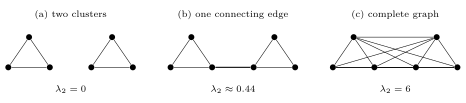
Fig. 2 shows three edge sets on the
same six nodes: adding edges increases $\eigval{2}$ from $0$, for
two clusters without a connecting edge, to $6$, for the
complete graph. The
eigenvector corresponding to $\eigval{2}$, referred to as the
Fiedler vector, can be used to partition $\graph$ into
two clusters: each node is assigned according to the sign of
its own entry in the
Fiedler vector (Fiedler, 1975; Spielman, 2025).
pythondemos/eigenvalue.py
@misc{dictml_eigenvalue,
  author = {Jung, Alexander},
  editor = {Olioumtsevits, Konstantina and Schnoor, Ekkehard},
  title = {eigenvalue},
  howpublished = {Dictionary of Applied Machine Learning (course edition)},
  year = {2026},
  doi = {10.5281/zenodo.21569296},
  note = {ISBN 978-952-64-3013-3, CC BY 4.0, retrieved 2026-09-21},
  url = {https://dictionaryofml.org/terms/eigenvalue.html}
}