featureimportance.py, which recomputes what the entry states: the script block by block · open in ColabDictionary of Applied Machine Learning: 107 machine-learning terms, each with a definition, a figure, citations and a Python demo · All terms · Demos · Start here
Updated on 2026-09-14
Readiness 98/100
An importance score assigns a number to each feature of a learned hypothesis. With standardized features, a linear model's coefficient magnitude equals prediction change per standard deviation. Permutation importance is the average-loss increase when a feature is permuted across data points. Scores are computed for the hypothesis and scoring dataset.
featureimportance.py, which recomputes what the entry states: the script block by block · open in ColabB-modelAn importance score assigns a
number to each feature of a learned hypothesis
$\learnthypothesis$. Predict
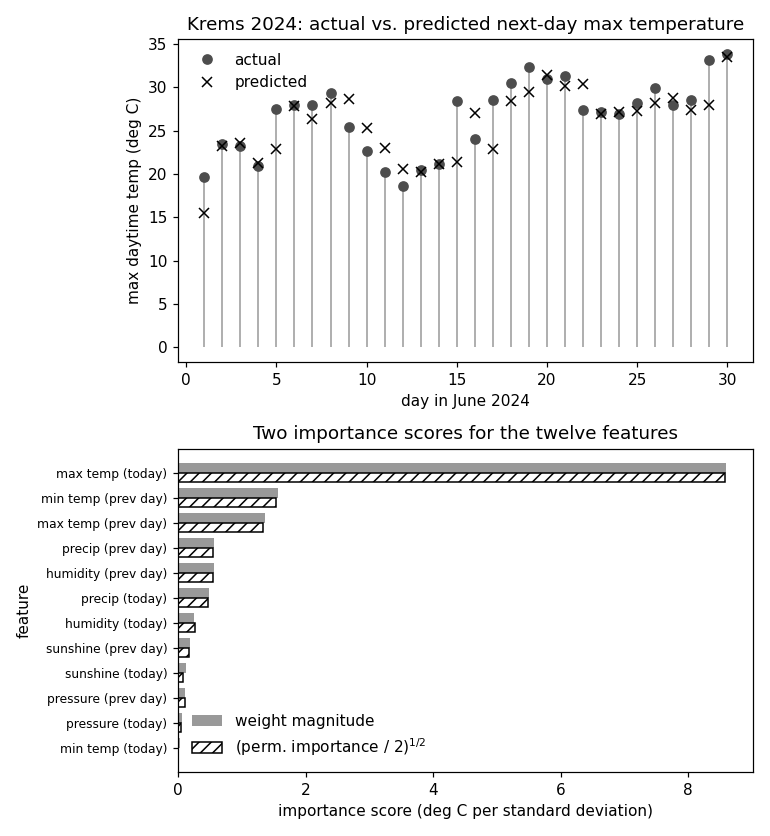
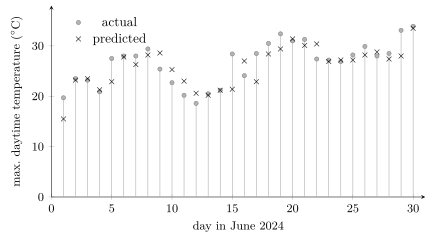
tomorrow's daytime peak at a weather station from twelve
features: today's and the previous day's high and low
temperature, air pressure, humidity, sunshine duration and
precipitation. A hypothesis learned by
linear regression from one year predicts the next day's high with
average squared error loss $8.8$, versus
label variance $84.6$ (in squared degrees
Celsius; Fig. 1).
pythondemos/featureimportance.py
Variable-importance scores appear in random forests (Breiman, 2001). Permutation importance uses predictions from a fitted hypothesis (Fisher et al., 2019; Molnar, 2025). On the scoring dataset, the $\featureidx$-th feature's score is the average-loss increase after shuffling its column. Denote it $I_{\featureidx}$.
B-permuteWith standardized features and squared error loss,
replacing $\feature_{\featureidx}$ by an independent draw
$\feature_{\featureidx}^{\prime}$ changes the
prediction by
$\delta_{\featureidx}=\widehat{\weight}_{\featureidx}
(\feature_{\featureidx}^{\prime}-\feature_{\featureidx})$.
The squared error loss increase is
$\delta_{\featureidx}^{2}
-2(\truelabel-\learnthypothesis(\featurevec))
\delta_{\featureidx}$, where $\truelabel$ is the
label. Standardization gives unit variance, and
zero covariance between
$\feature_{\featureidx}$ and
$\feature_{\featureidx}^{\prime}$ implies
$\expect\{(\feature_{\featureidx}^{\prime}
-\feature_{\featureidx})^{2}\}=2$. If the
prediction error is uncorrelated with
$\delta_{\featureidx}$, the cross-term averages out:
$I_{\featureidx} \approx
\expect\{\delta_{\featureidx}^{2}\} =
2\widehat{\weight}_{\featureidx}^{2}$
(Gregorutti et al., 2017).
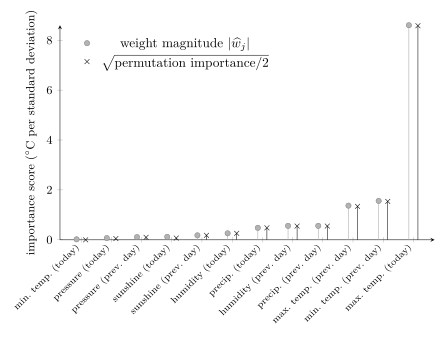
Fig. 2 plots
$\sqrt{I_{\featureidx}/2}$ next to
$|\widehat{\weight}_{\featureidx}|$; the two scores rank the
features almost identically.
pythondemos/featureimportance.py
Synonyms: variable importance.
See also: feature, linear model, loss.
@misc{dictml_featureimportance,
  author = {Jung, Alexander},
  editor = {Olioumtsevits, Konstantina and Schnoor, Ekkehard},
  title = {feature importance},
  howpublished = {Dictionary of Applied Machine Learning (course edition)},
  year = {2026},
  doi = {10.5281/zenodo.21569296},
  note = {ISBN 978-952-64-3013-3, CC BY 4.0, retrieved 2026-10-27},
  url = {https://dictionaryofml.org/terms/featureimportance.html}
}