baselearner.py, which recomputes what the entry states: the script block by block · open in ColabDictionary of Applied Machine Learning: 114 machine-learning terms, each with a definition, a figure, citations and a Python demo · All terms · Demos · Start here
Updated on 2026-10-31
Readiness 53/100
See also ensemble bagging boosting
baselearner.py, which recomputes what the entry states: the script block by block · open in ColabB-baseA base learner is an machine learning (ML) method used within an ensemble. Formally, it is an algorithm $\mathcal{A}$ that reads a training set $\mathcal{D}^{(\rm train)}$ and produces a learned hypothesis $\widehat{h}=\mathcal{A}(\mathcal{D}^{(\rm train)})$. An ensemble method runs several base learners and combines their learned hypotheses into a more suitable hypothesis.
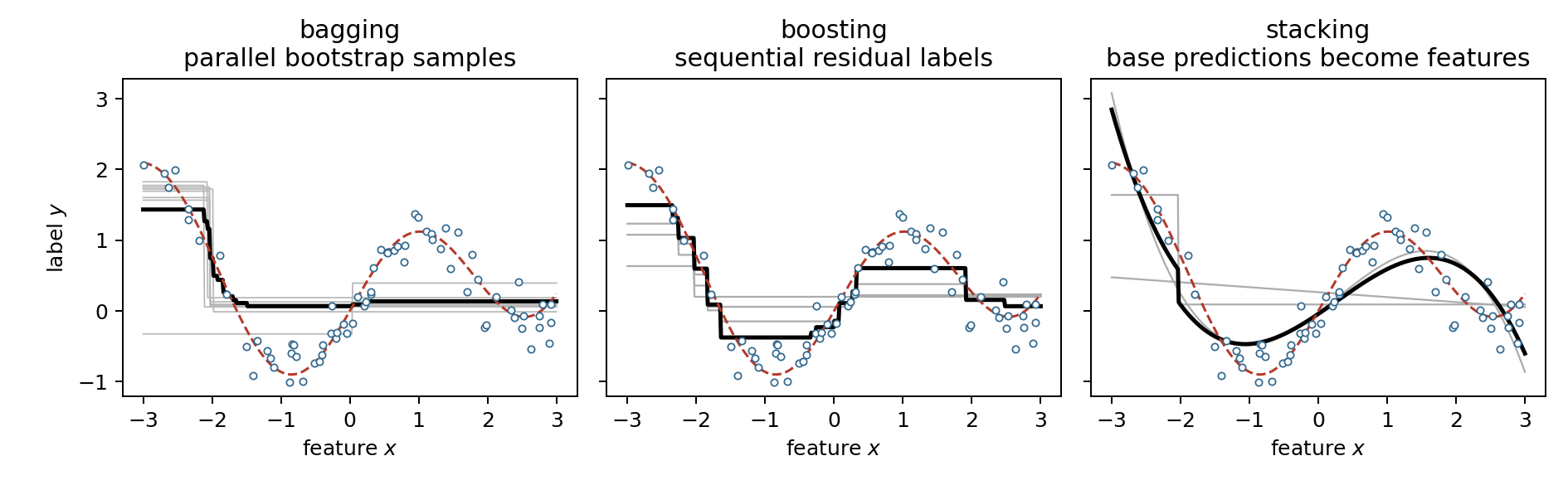
B-bagThe main approaches differ in how they construct the training sets and combine the results. Bagging trains base learners in parallel on samples generated by the bootstrap. Boosting trains them sequentially, using earlier results to modify the training set for the next base learner. Stacking uses their predictions as a feature transformation and learns an aggregation rule from the transformed features (Hastie et al., 2009, Ch. 8).
See also: ensemble, bagging, stacking, boosting.
@misc{dictml_baselearner,
  author = {Jung, Alexander},
  editor = {Olioumtsevits, Konstantina and Schnoor, Ekkehard},
  title = {base learner},
  howpublished = {Dictionary of Applied Machine Learning (course edition)},
  year = {2026},
  doi = {10.5281/zenodo.21569296},
  note = {ISBN 978-952-64-3013-3, CC BY 4.0, retrieved 2026-11-02},
  url = {https://dictionaryofml.org/terms/baselearner.html}
}