boosting.py, which recomputes what the entry states: the script block by block · open in ColabDictionary of Applied Machine Learning: 107 machine-learning terms, each with a definition, a figure, citations and a Python demo · All terms · Demos · Start here
Updated on 2026-10-22
Readiness 100/100
Boosting is an iterative optimization method that sequentially combines base learners, referred to as weak learners. Starting from an initial hypothesis, each iteration adds the hypothesis of a base learner, scaled by a learning rate, to the current hypothesis. This update generalizes the gradient step of gradient-based methods for empirical risk minimization (ERM): each new base learner corrects what the previous ones got wrong. Gradient boosting is the special case of this scheme with decision trees as base learners.
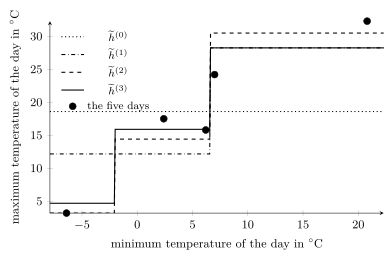
boosting.py, which recomputes what the entry states: the script block by block · open in ColabA weather station records, for each day, the minimum and the maximum temperature. Predicting the maximum from the minimum is a regression task, and a single decision tree of depth one answers it with two numbers: one prediction below a threshold on the minimum temperature and one above it. Such a tree is too coarse to follow five days recorded at Krems an der Donau (Fig. 1). Boosting adds a second tree that corrects the predictions of the first, a third that corrects what the first two leave over, and so on.
B-kremsBoosting combines a sequence of base learners, each
trained to correct what the previous ones got wrong, into one
accurate hypothesis (referred to as a strong learner)
(Drucker, 1997; Hastie et al., 2009, Ch. 10;
Ridgeway et al., 1999; Schapire, 1999).
pythondemos/boosting.py
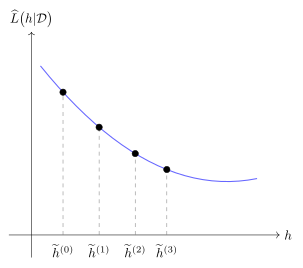
Boosting methods start from an initial hypothesis
$\widetilde{\hypothesis}^{(0)}$, which is iteratively improved by
the update
\[ \widetilde{\hypothesis}^{(\iteridx)} = \widetilde{\hypothesis}^{(\iteridx-1)}+
\lrate^{(\iteridx)}
\learntlocalhypothesis{\iteridx}\text{.}\]
Here, $\lrate^{(\iteridx)}$ denotes a learning rate and
$\learntlocalhypothesis{\iteridx}$ is provided by the
$\iteridx$-th base learner (see
Fig. 2).
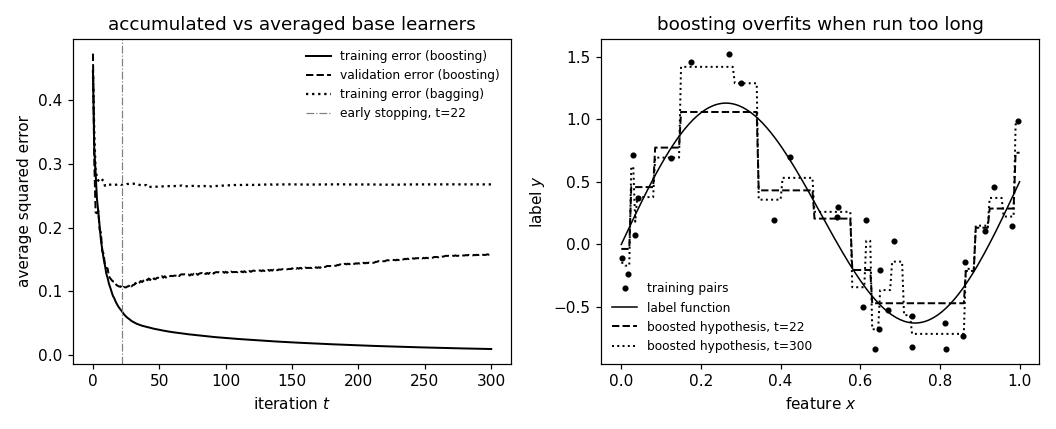
B-gradstepThe $\iteridx$-th base learner is trained to compensate the prediction errors incurred by the current hypothesis on the training set, $\truelabel^{(\sampleidx)} - \widetilde{\hypothesis}^{(\iteridx-1)}(\featurevec^{(\sampleidx)})$ for $\sampleidx = 1, \ldots, \samplesize$. For the squared error loss these errors are the negative gradient of the training error with respect to the current predictions (Friedman, 2001). Its output $\learntlocalhypothesis{\iteridx}$ therefore plays the role of a negative gradient.
B-overfitThe update is a fixed-point iteration on the hypothesis space, $\widetilde{\hypothesis}^{(\iteridx)} = T\big(\widetilde{\hypothesis}^{(\iteridx-1)}\big)$ with the operator $T(\hypothesis) \defeq \hypothesis + \lrate \, B(\hypothesis)$, where $B(\hypothesis)$ is the base learner fitted to the prediction errors of $\hypothesis$ on the training set. A hypothesis is a fixed point of $T$ when the base learner fitted to its prediction errors no longer points downhill, so that a step in its direction would not decrease the training error; boosting halts there (Mason et al., 1999, Sect. 2). If the training error is convex in the predictions and each iteration picks the base learner that decreases it most, every accumulation point of the sequence $\widetilde{\hypothesis}^{(\iteridx)}$ attains the smallest training error the base learners can reach (Mason et al., 1999, Thm. 2).
Boosting methods differ in their choice of base learners for computing the generalized gradients $\learntlocalhypothesis{\iteridx}$. For instance, gradient boosting most commonly uses decision trees as base learners (Hastie et al., 2009, Sect. 10.9).
See also: ensemble, adaptive boosting, gradient boosting, base learner, gradient-based method, bagging, early stopping.
@misc{dictml_boosting,
  author = {Jung, Alexander},
  editor = {Olioumtsevits, Konstantina and Schnoor, Ekkehard},
  title = {boosting},
  howpublished = {Dictionary of Applied Machine Learning (course edition)},
  year = {2026},
  doi = {10.5281/zenodo.21569296},
  note = {ISBN 978-952-64-3013-3, CC BY 4.0, retrieved 2026-10-27},
  url = {https://dictionaryofml.org/terms/boosting.html}
}