B-plot writes when the script runsDictionary of Applied Machine Learning · reinforcement learning
Numerical companion to the entry reinforcement learning: it recomputes what the entry states and prints one line per check
Numerical companion to the glossary entry 'reinforcementlearning' (reinforcement learning (RL)). The gridworld is the one of the entry 'gridworld': a 4 x 4 lattice of cells (row, col) with row 0 at the bottom, a wall at cell (2, 2), a goal at cell (3, 3), and the four moves up, down, left, right. A move that would leave the grid or enter the wall leaves the agent in place. Every move yields reward -1, except the move that enters the goal, which yields +1 and ends the episode (the goal is absorbing). No discounting (gamma = 1): every episode ends after finitely many moves under every policy considered here.
Run it with python3 reinforcementlearning.py, from any directory — it writes its output files into the current directory. Requires NumPy and Matplotlib only, and uses fixed seeds, so the printed numbers reproduce exactly. Download reinforcementlearning.py · Notebook · Open in Colab
One cell per block of the script: the code, and what that code printed when it last ran here
"""Reinforcement learning on a 4 x 4 gridworld: the value function of a
policy is the fixed point of its Bellman operator, the greedy policy is
optimal, and Q-learning finds the same policy from interaction alone.

Purpose
-------
Numerical companion to the glossary entry 'reinforcementlearning'
(reinforcement learning (RL)).  The gridworld is the one of the entry
'gridworld': a 4 x 4 lattice of cells (row, col) with row 0 at the
bottom, a wall at cell (2, 2), a goal at cell (3, 3), and the four moves
up, down, left, right.  A move that would leave the grid or enter the
wall leaves the agent in place.  Every move yields reward -1, except the
move that enters the goal, which yields +1 and ends the episode (the
goal is absorbing).  No discounting (gamma = 1): every episode ends after
finitely many moves under every policy considered here.

The demo checks the entry's claims: (1) the state-value function of the
equiprobable random policy is the fixed point of the policy's Bellman
operator, reached by iterating it from zero (iterative policy
evaluation); (2) the greedy policy with respect to that value function
already reaches the goal on a shortest path from every cell, and its
value function is the optimal one, 2 - d(s) with d(s) the shortest path
length to the goal; (3) Q-learning with random moves for exploration, which
never uses the transition function and learns only from the rewards of
the actions it tried, arrives at the same optimal policy, and its return
per episode rises from that of a random walk to the optimum -- delayed
reward at work, since the +1 arrives only at the last move.

Deterministic: fixed seed for the exploration noise.  Self-contained:
numpy + matplotlib only.

Blocks
------
[B-gridworld] Build the MDP: 15 states (16 cells minus the wall), 4
              actions, deterministic transition function, reward -1 per
              move and +1 for entering the goal; check the boundary and
              wall rules.
[B-evaluate]  Iterative policy evaluation of the random policy: apply the
              Bellman operator of the policy from v = 0 until the change
              is below 1e-10; check the result is a fixed point, that
              the iteration converged, and that the values are negative
              and decrease with the distance to the goal.
[B-improve]   Greedy policy with respect to the random policy's value
              function: check it reaches the goal from every cell in the
              shortest number of moves, and that its value function is
              the optimal one, 2 - d(s).
[B-qlearning] Q-learning (exploration probability 0.1, update weight 0.5) over 400
              episodes from random start cells, learning from the
              rewards of the actions tried only; check that the greedy
              policy of the learned Q equals the optimal policy and that
              the average return of the last 50 episodes exceeds that of
              the first 50.
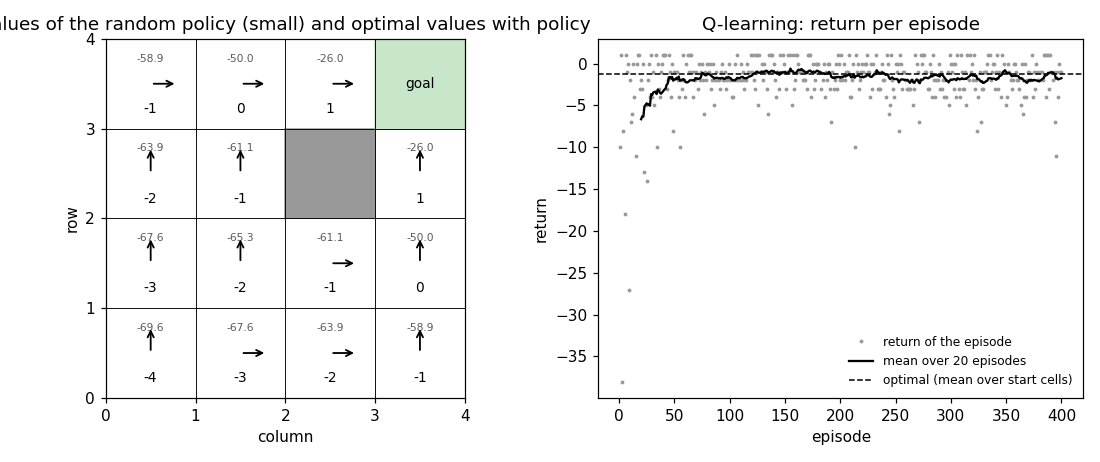
[B-plot]      Preview: the gridworld with the optimal values and policy
              arrows, and the return per episode of Q-learning.

Outputs
-------
reinforcementlearning_values.csv   : row, col, v_random, v_optimal, action
                                     (optimal move) per non-wall cell
reinforcementlearning_returns.csv  : episode, return, running mean over
                                     20 episodes (Q-learning)
reinforcementlearning.png          : preview (checking only)
"""

import numpy as np
import matplotlib

matplotlib.use("Agg")
import matplotlib.pyplot as plt

from pathlib import Path

OUT_DIR = Path(__file__).parent

report = []


def check(name, ok):
    report.append((name, bool(ok)))
    print(f"  [{'ok' if ok else 'FAIL'}] {name}")
Build the MDP: 15 states (16 cells minus the wall), 4 actions, deterministic transition function, reward -1 per move and +1 for entering the goal; check the boundary and wall rules.
H, W = 4, 4
WALL, GOAL = (2, 2), (3, 3)
ACTIONS = {"up": (1, 0), "down": (-1, 0), "left": (0, -1), "right": (0, 1)}
STATES = [(r, c) for r in range(H) for c in range(W) if (r, c) != WALL]


def step(s, a):
    """Next state and reward of a deterministic move; the goal is absorbing."""
    if s == GOAL:
        return s, 0.0
    dr, dc = ACTIONS[a]
    n = (s[0] + dr, s[1] + dc)
    if not (0 <= n[0] < H and 0 <= n[1] < W) or n == WALL:
        n = s
    return n, (1.0 if n == GOAL else -1.0)


check("[B-gridworld] 15 states and 4 actions", len(STATES) == 15 and len(ACTIONS) == 4)
check("[B-gridworld] a move into the boundary or the wall leaves the agent in place",
      step((0, 0), "down")[0] == (0, 0) and step((1, 2), "up")[0] == (1, 2))
check("[B-gridworld] entering the goal yields +1, any other move -1",
      step((3, 2), "right") == (GOAL, 1.0) and step((0, 0), "up") == ((1, 0), -1.0))
  [ok] [B-gridworld] 15 states and 4 actions
  [ok] [B-gridworld] a move into the boundary or the wall leaves the agent in place
  [ok] [B-gridworld] entering the goal yields +1, any other move -1
  policy evaluation: 1421 sweeps; v_random(0,0) = -69.60, v_random(3,2) = -26.00
Iterative policy evaluation of the random policy: apply the Bellman operator of the policy from v = 0 until the change is below 1e-10; check the result is a fixed point, that the iteration converged, and that the values are negative and decrease with the distance to the goal.
def bellman_policy(v, policy):
    """One application of the Bellman operator of a policy (gamma = 1):
    (T v)(s) = sum_a pi(a|s) [r(s,a) + v(s')]."""
    out = {}
    for s in STATES:
        if s == GOAL:
            out[s] = 0.0
            continue
        out[s] = sum(p * (step(s, a)[1] + v[step(s, a)[0]])
                     for a, p in policy[s].items())
    return out


random_policy = {s: {a: 0.25 for a in ACTIONS} for s in STATES}
v = {s: 0.0 for s in STATES}
sweeps, deltas = 0, []
while True:
    v_new = bellman_policy(v, random_policy)
    delta = max(abs(v_new[s] - v[s]) for s in STATES)
    deltas.append(delta); v = v_new; sweeps += 1
    if delta < 1e-10 or sweeps > 10_000:
        break
v_random = v
print(f"  policy evaluation: {sweeps} sweeps; v_random(0,0) = {v_random[(0, 0)]:.2f}, "
      f"v_random(3,2) = {v_random[(3, 2)]:.2f}")
check("[B-evaluate] the iteration converged (change below 1e-10)", deltas[-1] < 1e-10)
check("[B-evaluate] the result is a fixed point of the policy's Bellman operator",
      max(abs(bellman_policy(v_random, random_policy)[s] - v_random[s]) for s in STATES) < 1e-8)


def shortest(s):
    """Shortest number of moves from s to the goal (breadth-first search)."""
    from collections import deque
    seen, q = {s: 0}, deque([s])
    while q:
        u = q.popleft()
        if u == GOAL:
            return seen[u]
        for a in ACTIONS:
            n = step(u, a)[0]
            if n not in seen:
                seen[n] = seen[u] + 1; q.append(n)
    return None


d = {s: shortest(s) for s in STATES}
check("[B-evaluate] the random policy's values are negative away from the goal "
      "and decrease with the distance to it",
      all(v_random[s] < 0 for s in STATES if s != GOAL)
      and all(v_random[s] >= v_random[t] for s in STATES for t in STATES
              if d[s] < d[t]))
  [ok] [B-evaluate] the iteration converged (change below 1e-10)
  [ok] [B-evaluate] the result is a fixed point of the policy's Bellman operator
  [ok] [B-evaluate] the random policy's values are negative away from the goal and decrease with the distance to it
Greedy policy with respect to the random policy's value function: check it reaches the goal from every cell in the shortest number of moves, and that its value function is the optimal one, 2 - d(s).
def greedy(vfun):
    pol = {}
    for s in STATES:
        if s == GOAL:
            pol[s] = None; continue
        pol[s] = max(ACTIONS, key=lambda a: step(s, a)[1] + vfun[step(s, a)[0]])
    return pol


greedy_policy = greedy(v_random)


def rollout(pol, s, limit=100):
    """Return and number of moves when following pol from s."""
    G, n = 0.0, 0
    while s != GOAL and n < limit:
        s, r = step(s, pol[s]); G += r; n += 1
    return G, n


check("[B-improve] the greedy policy reaches the goal on a shortest path from every cell",
      all(rollout(greedy_policy, s)[1] == d[s] for s in STATES if s != GOAL))
v_greedy = {s: rollout(greedy_policy, s)[0] for s in STATES}
v_optimal = {s: (0.0 if s == GOAL else 2.0 - d[s]) for s in STATES}
check("[B-improve] its value function is the optimal one, 2 - d(s)",
      all(abs(v_greedy[s] - v_optimal[s]) < 1e-12 for s in STATES))
check("[B-improve] the optimal values are a fixed point of the optimal Bellman "
      "operator", all(abs(max(step(s, a)[1] + v_optimal[step(s, a)[0]] for a in ACTIONS)
                           - v_optimal[s]) < 1e-12 for s in STATES if s != GOAL))
  [ok] [B-improve] the greedy policy reaches the goal on a shortest path from every cell
  [ok] [B-improve] its value function is the optimal one, 2 - d(s)
  [ok] [B-improve] the optimal values are a fixed point of the optimal Bellman operator
Q-learning (exploration probability 0.1, update weight 0.5) over 400 episodes from random start cells, learning from the rewards of the actions tried only; check that the greedy policy of the learned Q equals the optimal policy and that the average return of the last 50 episodes exceeds that of the first 50.
rng = np.random.default_rng(0)
EPS, ALPHA_Q, EPISODES = 0.1, 0.5, 400
Q = {s: {a: 0.0 for a in ACTIONS} for s in STATES}
starts = [s for s in STATES if s != GOAL]
returns = []
for ep in range(EPISODES):
    s = starts[rng.integers(len(starts))]
    G, n = 0.0, 0
    while s != GOAL and n < 200:
        if rng.random() < EPS:
            a = list(ACTIONS)[rng.integers(4)]
        else:
            a = max(ACTIONS, key=lambda x: Q[s][x])
        n_s, r = step(s, a)
        target = r + (0.0 if n_s == GOAL else max(Q[n_s].values()))
        Q[s][a] += ALPHA_Q * (target - Q[s][a])
        G += r; s = n_s; n += 1
    returns.append(G)
returns = np.array(returns)
q_policy = {s: (None if s == GOAL else max(ACTIONS, key=lambda a: Q[s][a])) for s in STATES}
check("[B-qlearning] the greedy policy of the learned Q reaches the goal on a "
      "shortest path from every cell",
      all(rollout(q_policy, s)[1] == d[s] for s in STATES if s != GOAL))
first, last = returns[:50].mean(), returns[-50:].mean()
print(f"  Q-learning: mean return first 50 episodes {first:.1f}, last 50 episodes {last:.1f}"
      f" (optimum averaged over start cells {np.mean([v_optimal[s] for s in starts]):.1f})")
check("[B-qlearning] the average return of the last 50 episodes exceeds that of "
      "the first 50", last > first)

# ---- CSVs
with open(OUT_DIR / "reinforcementlearning_values.csv", "w") as f:
    f.write("row,col,v_random,v_optimal,action\n")
    for (r, c) in STATES:
        f.write(f"{r},{c},{v_random[(r, c)]:.2f},{v_optimal[(r, c)]:.0f},"
                f"{greedy_policy[(r, c)] or 'goal'}\n")
running = np.convolve(returns, np.ones(20) / 20, mode="full")[:EPISODES]
running[:19] = np.nan
with open(OUT_DIR / "reinforcementlearning_returns.csv", "w") as f:
    f.write("episode,ret,mean20\n")
    for i, (g, m) in enumerate(zip(returns, running), 1):
        f.write(f"{i},{g:.0f},{'nan' if np.isnan(m) else f'{m:.2f}'}\n")
  [ok] [B-qlearning] the greedy policy of the learned Q reaches the goal on a shortest path from every cell
  Q-learning: mean return first 50 episodes -4.3, last 50 episodes -1.8 (optimum averaged over start cells -1.3)
  [ok] [B-qlearning] the average return of the last 50 episodes exceeds that of the first 50

11/11 checks pass
Preview: the gridworld with the optimal values and policy arrows, and the return per episode of Q-learning.
fig, (ax1, ax2) = plt.subplots(1, 2, figsize=(10, 4.2))
ARROW = {"up": (0, 0.3), "down": (0, -0.3), "left": (-0.3, 0), "right": (0.3, 0)}
for r in range(H):
    for c in range(W):
        if (r, c) == WALL:
            ax1.add_patch(plt.Rectangle((c, r), 1, 1, color="0.6"))
            continue
        if (r, c) == GOAL:
            ax1.add_patch(plt.Rectangle((c, r), 1, 1, color="#c8e6c9"))
            ax1.text(c + 0.5, r + 0.5, "goal", ha="center", va="center", fontsize=9)
            continue
        ax1.text(c + 0.5, r + 0.78, f"{v_random[(r, c)]:.1f}", ha="center",
                 va="center", fontsize=7, color="0.35")
        ax1.text(c + 0.5, r + 0.22, f"{v_optimal[(r, c)]:.0f}", ha="center",
                 va="center", fontsize=9)
        dx, dy = ARROW[greedy_policy[(r, c)]]
        ax1.annotate("", xy=(c + 0.5 + dx, r + 0.5 + dy), xytext=(c + 0.5, r + 0.5),
                     arrowprops=dict(arrowstyle="->", lw=1.2))
ax1.set_xlim(0, W); ax1.set_ylim(0, H); ax1.set_xticks(range(W + 1)); ax1.set_yticks(range(H + 1))
ax1.grid(True, color="black", lw=0.6); ax1.set_aspect("equal")
ax1.set_xlabel("column"); ax1.set_ylabel("row")
ax1.set_title("Values of the random policy (small) and optimal values with policy")
ax2.plot(np.arange(1, EPISODES + 1), returns, ".", ms=3, color="0.6", label="return of the episode")
ax2.plot(np.arange(1, EPISODES + 1), running, "k-", lw=1.5, label="mean over 20 episodes")
ax2.axhline(np.mean([v_optimal[s] for s in starts]), ls="--", color="black",
            lw=1, label="optimal (mean over start cells)")
ax2.set_xlabel("episode"); ax2.set_ylabel("return")
ax2.set_title("Q-learning: return per episode")
ax2.legend(frameon=False, fontsize=8)
fig.tight_layout()
fig.savefig(OUT_DIR / "reinforcementlearning.png", dpi=110)

n_ok = sum(ok for _, ok in report)
print(f"\n{n_ok}/{len(report)} checks pass")
if n_ok != len(report):
    raise SystemExit(1)
B-plot writes when the script runs