B-plot writes when the script runsDictionary of Applied Machine Learning · soft clustering
Updated on 2026-11-19
Numerical companion to the entry soft clustering: it recomputes what the entry states and prints one line per check
Numerical companion to the glossary entry 'softclustering'. The 366 days of 2024 at Krems are data points with the feature vector (morning minimum temperature, maximum daytime temperature). A hard clustering (k-means) assigns every day to one of two clusters, the cold and the warm days. A soft clustering assigns every day a degree of belonging to each cluster: a vector with nonnegative entries that sum to one, a point of the probability simplex. A hard clustering is the special case where that vector is a vertex of the simplex.
Run it without installing anything:uv run https://dictionaryofml.org/terms/softclustering.py
uv downloads this script and the pinned NumPy and Matplotlib it needs, then runs it; the script fetches any input file it uses. To keep the output files, download softclustering.py into a folder and run uv run softclustering.py there. With NumPy and Matplotlib already installed, python3 softclustering.py, from any directory — it writes its output files into the current directory. Fixed seeds, so the printed numbers reproduce exactly. Download softclustering.py · Notebook · Open in Colab
Before running a downloaded copy, scan it: uvx bandit -q -t B102,B307,B602,B605 softclustering.py (B102,B307,B602,B605 are the exec, eval and shell checks of bandit) reports nothing: the script runs no shell command and evaluates no generated code.
One cell per block of the script: the code, and what that code printed when it last ran here
"""Soft clustering of the days of one year at Krems an der Donau: the
degree-of-belonging vector of a day as a point of the probability simplex.

Purpose
-------
Numerical companion to the glossary entry 'softclustering'.  The 366
days of 2024 at Krems are data points with the feature vector (morning
minimum temperature, maximum daytime temperature).  A hard clustering
(k-means) assigns every day to one of two clusters, the cold and the
warm days.  A soft clustering assigns every day a degree of belonging
to each cluster: a vector with nonnegative entries that sum to one, a
point of the probability simplex.  A hard clustering is the special
case where that vector is a vertex of the simplex.

The demo checks the entry's claims: the posterior probabilities of a
two-component Gaussian mixture model (GMM), learned by EM, are such
degree-of-belonging vectors and the negative log-likelihood never
increases along the EM iterations; a hard clustering is recovered by
the largest degree of belonging; with the covariance matrices fixed at
sigma^2 I and the cluster probabilities at 1/2, the degrees of
belonging turn into 0 or 1 as sigma^2 shrinks and then agree with the
nearest-centroid assignment of k-means; fuzzy c-means delivers degrees
of belonging without a probabilistic model, its alternating updates
never increase its objective, and it reduces to k-means as the
fuzzifier tends to 1.

Deterministic: Lloyd's algorithm starts from k-means++ seeds drawn with
a fixed seed; EM and fuzzy c-means start from the k-means centroids.
Self-contained: numpy + matplotlib only; the GeoSphere download falls
back to the committed CSV.

Blocks
------
[B-data]   Download the daily minimum and maximum temperature of 2024
           at Krems (GeoSphere station 3805) or read the committed
           copy; 366 days, no missing value.
[B-hard]   k-means with k = 2 (Lloyd's algorithm, best of 20 k-means++
           restarts): the two centroids, the cold and the warm days;
           the degree-of-belonging vector of every day is a vertex of
           the simplex.
[B-gmm]    EM for a two-component GMM with full covariance matrices,
           started at the k-means centroids: the degrees of belonging
           are the posterior probabilities, they sum to one for every
           day, the negative log-likelihood never increases, and the
           days whose largest degree of belonging is below 0.8 are
           counted; the clustering by the largest degree of belonging
           is compared with k-means.
[B-limit]  The constrained GMM with cluster probabilities 1/2 and
           covariance matrices sigma^2 I, means fixed at the k-means
           centroids: the number of days with a degree of belonging
           between 0.2 and 0.8 for sigma^2 = 25, 4, 1, and the
           agreement of the largest degree of belonging with the
           nearest centroid.
[B-fcm]    Fuzzy c-means with fuzzifier 2 (and 1.05, 10): the
           alternating updates never increase the objective, the
           degrees of belonging sum to one, the ambiguous days are
           counted, and the fuzzifier 1.05 recovers the k-means
           centroids and clustering error.
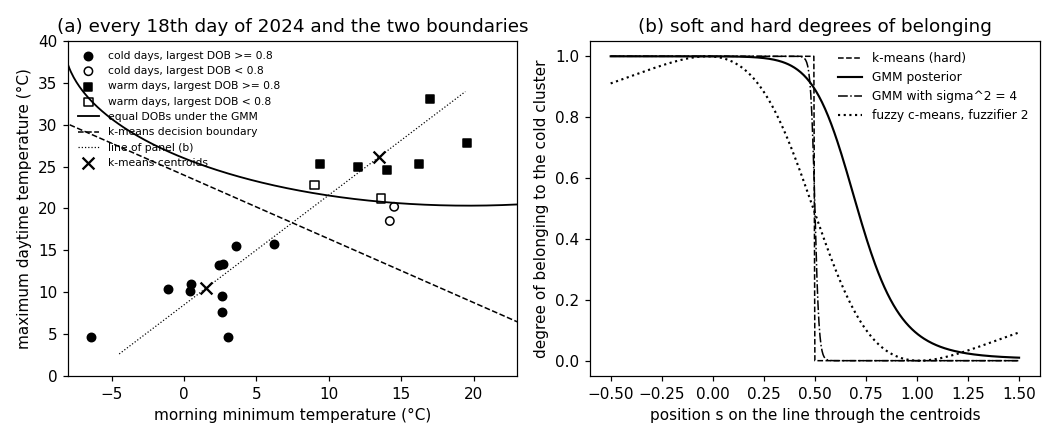
[B-plot]   Every 18th day for the figure (21 of 366 days) with the
           cluster of its largest GMM degree of belonging and whether
           that value reaches 0.8; the k-means centroids and their
           bisector; the curve of equal GMM degrees of belonging; and
           the degree of belonging to the cold cluster along the line
           through the two centroids under k-means, the GMM, the
           constrained GMM with sigma^2 = 4, and fuzzy c-means.

Outputs
-------
softclustering_weather.csv     : date, tmin, tmax (committed copy).
softclustering_points_plot.csv : the 21 drawn days, cluster, confident.
softclustering_centroids.csv   : the two k-means centroids.
softclustering_bisector.csv    : two points of the k-means decision
                                 boundary.
softclustering_contour.csv     : the curve of equal GMM posteriors.
softclustering_segment.csv     : s and the four degrees of belonging
                                 to the cold cluster along the line.
softclustering.png             : matplotlib preview (checking only).
"""

# /// script
# requires-python = ">=3.10"
# dependencies = ["matplotlib==3.10.7", "numpy==2.3.4"]
# ///

import json
import urllib.request
from pathlib import Path

import numpy as np
import matplotlib

matplotlib.use("Agg")
import matplotlib.pyplot as plt

OUT_DIR = Path(__file__).parent

report = []


def check(name, ok):
    report.append((name, bool(ok)))
    print(f"  [{'ok' if ok else 'FAIL'}] {name}")
Download the daily minimum and maximum temperature of 2024 at Krems (GeoSphere station 3805) or read the committed copy; 366 days, no missing value.
print("[B-data] daily minimum and maximum temperature at Krems, 2024")
URL = ("https://dataset.api.hub.geosphere.at/v1/station/historical/"
       "klima-v2-1d?parameters=tlmin,tlmax&station_ids=3805"
       "&start=2024-01-01&end=2024-12-31")
CSV = OUT_DIR / "softclustering_weather.csv"
try:
    with urllib.request.urlopen(URL, timeout=120) as resp:
        payload = json.load(resp)
    params = payload["features"][0]["properties"]["parameters"]
    records = [(stamp[:10], lo, hi)
               for stamp, lo, hi in zip(payload["timestamps"],
                                        params["tlmin"]["data"],
                                        params["tlmax"]["data"])]
    with open(CSV, "w") as fh:
        fh.write("date,tmin,tmax\n")
        for day, lo, hi in records:
            fh.write(f"{day},{lo},{hi}\n")
    print(f"    downloaded {len(records)} days")
except OSError as err:
    print(f"    download failed ({err}); reading the committed CSV")
    rows = CSV.read_text().strip().splitlines()[1:]
    records = [(d, float(a), float(b))
               for d, a, b in (r.split(",") for r in rows)]

check("[B-data] 366 days for 2024", len(records) == 366)
check("[B-data] no day is missing a temperature",
      all(lo is not None and hi is not None for _, lo, hi in records))
X = np.array([[lo, hi] for _, lo, hi in records], dtype=float)
m, d = X.shape
K = 2


def sq_euclid(x, w):
    return np.sum((x - w) ** 2, axis=-1)


def sq_dist_matrix(X, W):
    """m x k matrix of squared Euclidean distances to the centroids W."""
    return np.stack([sq_euclid(X, w) for w in W], axis=1)
[B-data] daily minimum and maximum temperature at Krems, 2024
    downloaded 366 days
  [ok] [B-data] 366 days for 2024
  [ok] [B-data] no day is missing a temperature
k-means with k = 2 (Lloyd's algorithm, best of 20 k-means++ restarts): the two centroids, the cold and the warm days; the degree-of-belonging vector of every day is a vertex of the simplex.
print("[B-hard] k-means with k = 2")


def lloyd(X, W0, max_iter=500):
    W = np.array(W0, dtype=float)
    c = np.argmin(sq_dist_matrix(X, W), axis=1)
    for _ in range(max_iter):
        W = np.array([X[c == j].mean(axis=0) if np.any(c == j) else W[j]
                      for j in range(len(W))])
        c_new = np.argmin(sq_dist_matrix(X, W), axis=1)
        if np.array_equal(c_new, c):
            break
        c = c_new
    return W, c, float(np.mean(np.min(sq_dist_matrix(X, W), axis=1)))


def kmeanspp_seeds(X, k, rng):
    W = [X[rng.integers(m)]]
    for _ in range(1, k):
        d2 = np.min(sq_dist_matrix(X, np.array(W)), axis=1)
        W.append(X[rng.choice(m, p=d2 / d2.sum())])
    return np.array(W)


rng = np.random.default_rng(2024)
best = None
for _ in range(20):
    W, c, err = lloyd(X, kmeanspp_seeds(X, K, rng))
    if best is None or err < best[2]:
        best = (W, c, err)
W_km, c_km, err_km = best
cold, warm = sorted(range(K), key=lambda j: W_km[j, 1])
if cold != 0:  # cluster 1 is the cold one throughout
    W_km = W_km[[cold, warm]]
    c_km = np.where(c_km == cold, 0, 1)
    cold, warm = 0, 1
U_km = np.eye(K)[c_km]  # one-hot rows: the vertices of the simplex
check(f"[B-hard] centroids ({W_km[0, 0]:.1f}, {W_km[0, 1]:.1f}) with "
      f"{int(np.sum(c_km == 0))} cold days and ({W_km[1, 0]:.1f}, "
      f"{W_km[1, 1]:.1f}) with {int(np.sum(c_km == 1))} warm days; "
      f"clustering error {err_km:.1f}",
      W_km[0, 1] < 12 < W_km[1, 1])
check("[B-hard] the degree-of-belonging vector of every day is a vertex "
      "of the simplex: entries in {0, 1} that sum to one",
      np.all(np.isin(U_km, (0.0, 1.0))) and np.allclose(U_km.sum(axis=1), 1))
[B-hard] k-means with k = 2
  [ok] [B-hard] centroids (1.5, 10.5) with 192 cold days and (13.4, 26.1) with 174 warm days; clustering error 42.0
  [ok] [B-hard] the degree-of-belonging vector of every day is a vertex of the simplex: entries in {0, 1} that sum to one
EM for a two-component GMM with full covariance matrices, started at the k-means centroids: the degrees of belonging are the posterior probabilities, they sum to one for every day, the negative log-likelihood never increases, and the days whose largest degree of belonging is below 0.8 are counted; the clustering by the largest degree of belonging is compared with k-means.
print("[B-gmm] EM for a two-component GMM with full covariance matrices")


def mvn_pdf(X, mu, C):
    Ci = np.linalg.inv(C)
    diff = X - mu
    q = np.einsum("ij,jk,ik->i", diff, Ci, diff)
    return np.exp(-0.5 * q) / np.sqrt((2 * np.pi) ** d * np.linalg.det(C))


def gmm_posterior(X, p, mu, C):
    dens = np.stack([p[j] * mvn_pdf(X, mu[j], C[j]) for j in range(K)],
                    axis=1)
    return dens / dens.sum(axis=1, keepdims=True), -np.mean(
        np.log(dens.sum(axis=1)))


def em_gmm(X, mu0, max_iter=1000, tol=1e-12):
    p = np.full(K, 1.0 / K)
    mu = np.array(mu0, dtype=float)
    C = np.array([np.cov(X.T)] * K)
    nll = []
    for _ in range(max_iter):
        U, value = gmm_posterior(X, p, mu, C)  # E-step
        nll.append(value)
        Nk = U.sum(axis=0)  # M-step
        p = Nk / m
        mu = (U.T @ X) / Nk[:, None]
        for j in range(K):
            diff = X - mu[j]
            C[j] = (U[:, j, None] * diff).T @ diff / Nk[j]
        if len(nll) > 1 and nll[-2] - nll[-1] < tol:
            break
    U, value = gmm_posterior(X, p, mu, C)
    nll.append(value)
    return p, mu, C, U, nll


p_g, mu_g, C_g, U_g, nll = em_gmm(X, W_km)
check(f"[B-gmm] EM stopped after {len(nll) - 1} iterations; cluster "
      f"probabilities ({p_g[0]:.2f}, {p_g[1]:.2f}), means "
      f"({mu_g[0, 0]:.1f}, {mu_g[0, 1]:.1f}) and ({mu_g[1, 0]:.1f}, "
      f"{mu_g[1, 1]:.1f})", mu_g[0, 1] < mu_g[1, 1])
check("[B-gmm] the negative log-likelihood never increases along the "
      f"EM iterations ({nll[0]:.3f} -> {nll[-1]:.3f})",
      all(b <= a + 1e-9 for a, b in zip(nll, nll[1:])))
check("[B-gmm] every day's degrees of belonging are nonnegative and sum "
      "to one (a point of the simplex)",
      np.all(U_g >= 0) and np.allclose(U_g.sum(axis=1), 1))
n_amb_g = int(np.sum(U_g.max(axis=1) < 0.8))
check(f"[B-gmm] {n_amb_g} of the {m} days have no degree of belonging "
      f"of 0.8 or more", 0 < n_amb_g < m / 4)
c_g = np.argmax(U_g, axis=1)
agree_g = float(np.mean(c_g == c_km))
check(f"[B-gmm] the cluster of the largest degree of belonging agrees "
      f"with k-means on {100 * agree_g:.1f}% of the days "
      f"({int(np.sum(c_g == c_km))} of {m})", agree_g > 0.85)
months = np.array([int(day[5:7]) for day, _, _ in records])
amb_months = np.bincount(months[U_g.max(axis=1) < 0.8], minlength=13)
check("[B-gmm] no day of January, February, November or December is "
      f"ambiguous; ambiguous days per month: {amb_months[1:].tolist()}",
      amb_months[[1, 2, 11, 12]].sum() == 0)
[B-gmm] EM for a two-component GMM with full covariance matrices
  [ok] [B-gmm] EM stopped after 273 iterations; cluster probabilities (0.63, 0.37), means (3.1, 12.4) and (14.2, 27.5)
  [ok] [B-gmm] the negative log-likelihood never increases along the EM iterations (6.374 -> 6.247)
  [ok] [B-gmm] every day's degrees of belonging are nonnegative and sum to one (a point of the simplex)
  [ok] [B-gmm] 58 of the 366 days have no degree of belonging of 0.8 or more
  [ok] [B-gmm] the cluster of the largest degree of belonging agrees with k-means on 91.5% of the days (335 of 366)
  [ok] [B-gmm] no day of January, February, November or December is ambiguous; ambiguous days per month: [0, 0, 4, 8, 23, 8, 2, 1, 10, 2, 0, 0]
The constrained GMM with cluster probabilities 1/2 and covariance matrices sigma^2 I, means fixed at the k-means centroids: the number of days with a degree of belonging between 0.2 and 0.8 for sigma^2 = 25, 4, 1, and the agreement of the largest degree of belonging with the nearest centroid.
print("[B-limit] the constrained GMM at the k-means centroids as sigma^2 "
      "shrinks")


def constrained_dob(X, W, sigma2):
    """Posterior under equal cluster probabilities and covariance
    sigma^2 I with means W; computed in the log domain."""
    L = -sq_dist_matrix(X, W) / (2 * sigma2)
    L -= L.max(axis=1, keepdims=True)
    U = np.exp(L)
    return U / U.sum(axis=1, keepdims=True)


between = {}
for sigma2 in (25.0, 4.0, 1.0):
    U_s = constrained_dob(X, W_km, sigma2)
    between[sigma2] = int(np.sum((U_s[:, 0] > 0.2) & (U_s[:, 0] < 0.8)))
    check(f"[B-limit] sigma^2 = {sigma2:g}: {between[sigma2]} days with a "
          f"degree of belonging between 0.2 and 0.8; the largest degree "
          f"of belonging names the nearest centroid for every day",
          np.array_equal(np.argmax(U_s, axis=1), c_km))
check("[B-limit] the count of days between 0.2 and 0.8 falls with "
      "sigma^2 and reaches zero",
      between[25.0] > between[4.0] > between[1.0] == 0)
U_tiny = constrained_dob(X, W_km, 1e-4)
check("[B-limit] sigma^2 = 0.0001: every degree of belonging is 0 or 1 "
      "to within 1e-6 and equals the k-means vertex",
      np.allclose(U_tiny, U_km, atol=1e-6))
[B-limit] the constrained GMM at the k-means centroids as sigma^2 shrinks
  [ok] [B-limit] sigma^2 = 25: 26 days with a degree of belonging between 0.2 and 0.8; the largest degree of belonging names the nearest centroid for every day
  [ok] [B-limit] sigma^2 = 4: 3 days with a degree of belonging between 0.2 and 0.8; the largest degree of belonging names the nearest centroid for every day
  [ok] [B-limit] sigma^2 = 1: 0 days with a degree of belonging between 0.2 and 0.8; the largest degree of belonging names the nearest centroid for every day
  [ok] [B-limit] the count of days between 0.2 and 0.8 falls with sigma^2 and reaches zero
  [ok] [B-limit] sigma^2 = 0.0001: every degree of belonging is 0 or 1 to within 1e-6 and equals the k-means vertex
Fuzzy c-means with fuzzifier 2 (and 1.05, 10): the alternating updates never increase the objective, the degrees of belonging sum to one, the ambiguous days are counted, and the fuzzifier 1.05 recovers the k-means centroids and clustering error.
print("[B-fcm] fuzzy c-means")


def fcm_dob(X, W, phi):
    D2 = np.maximum(sq_dist_matrix(X, W), 1e-12)
    U = D2 ** (-1.0 / (phi - 1.0))
    return U / U.sum(axis=1, keepdims=True)


def fcm_objective(X, W, U, phi):
    return float(np.mean(np.sum(U ** phi * sq_dist_matrix(X, W), axis=1)))


def fcm(X, W0, phi, max_iter=1000, tol=1e-10):
    """Alternating updates: the degrees of belonging for fixed centroids,
    then the centroids for fixed degrees of belonging.  Returns the
    centroids, the degrees of belonging, and the objective after every
    half step."""
    W = np.array(W0, dtype=float)
    values = []
    for _ in range(max_iter):
        U = fcm_dob(X, W, phi)
        values.append(fcm_objective(X, W, U, phi))
        W_new = (U ** phi).T @ X / (U ** phi).sum(axis=0)[:, None]
        values.append(fcm_objective(X, W_new, U, phi))
        if np.allclose(W_new, W, atol=tol):
            W = W_new
            break
        W = W_new
    return W, fcm_dob(X, W, phi), values


fcm_runs = {}
for phi in (2.0, 1.05, 10.0):
    fcm_runs[phi] = fcm(X, W_km + 0.5, phi)
W_f, U_f, vals_f = fcm_runs[2.0]
check(f"[B-fcm] fuzzifier 2: {len(vals_f) // 2} iterations, the objective "
      f"never increases ({vals_f[0]:.2f} -> {vals_f[-1]:.2f}); centroids "
      f"({W_f[0, 0]:.1f}, {W_f[0, 1]:.1f}) and ({W_f[1, 0]:.1f}, "
      f"{W_f[1, 1]:.1f})",
      all(b <= a + 1e-9 for a, b in zip(vals_f, vals_f[1:])))
check("[B-fcm] fuzzifier 2: every day's degrees of belonging are "
      "nonnegative and sum to one",
      np.all(U_f >= 0) and np.allclose(U_f.sum(axis=1), 1))
n_amb_f = int(np.sum(U_f.max(axis=1) < 0.8))
check(f"[B-fcm] fuzzifier 2: {n_amb_f} days have no degree of belonging "
      f"of 0.8 or more (GMM: {n_amb_g})", 0 < n_amb_f < m / 4)
check("[B-fcm] fuzzifier 2: the largest degree of belonging names the "
      "nearest fuzzy c-means centroid for every day",
      np.array_equal(np.argmax(U_f, axis=1),
                     np.argmin(sq_dist_matrix(X, W_f), axis=1)))
W_1, U_1, vals_1 = fcm_runs[1.05]
n_sharp = int(np.sum(U_1.max(axis=1) > 0.99))
check(f"[B-fcm] fuzzifier 1.05: centroids within 0.05 of the k-means "
      f"centroids, objective {vals_1[-1]:.1f} within 0.1 of the k-means "
      f"clustering error {err_km:.1f}, and {n_sharp} of the {m} days have "
      f"a largest degree of belonging above 0.99",
      np.allclose(W_1, W_km, atol=0.05) and abs(vals_1[-1] - err_km) < 0.1
      and n_sharp >= m - 10)
W_10, U_10, _ = fcm_runs[10.0]
check(f"[B-fcm] fuzzifier 10: every degree of belonging lies between 0.25 "
      f"and 0.75 (smallest {U_10.min():.2f}, largest {U_10.max():.2f})",
      np.all((U_10 > 0.25) & (U_10 < 0.75)))
[B-fcm] fuzzy c-means
  [ok] [B-fcm] fuzzifier 2: 16 iterations, the objective never increases (35.18 -> 34.74); centroids (1.2, 10.0) and (13.6, 26.3)
  [ok] [B-fcm] fuzzifier 2: every day's degrees of belonging are nonnegative and sum to one
  [ok] [B-fcm] fuzzifier 2: 66 days have no degree of belonging of 0.8 or more (GMM: 58)
  [ok] [B-fcm] fuzzifier 2: the largest degree of belonging names the nearest fuzzy c-means centroid for every day
  [ok] [B-fcm] fuzzifier 1.05: centroids within 0.05 of the k-means centroids, objective 42.0 within 0.1 of the k-means clustering error 42.0, and 358 of the 366 days have a largest degree of belonging above 0.99
  [ok] [B-fcm] fuzzifier 10: every degree of belonging lies between 0.25 and 0.75 (smallest 0.26, largest 0.74)
Every 18th day for the figure (21 of 366 days) with the cluster of its largest GMM degree of belonging and whether that value reaches 0.8; the k-means centroids and their bisector; the curve of equal GMM degrees of belonging; and the degree of belonging to the cold cluster along the line through the two centroids under k-means, the GMM, the constrained GMM with sigma^2 = 4, and fuzzy c-means.
print("[B-plot] thinned scatter, boundary curves, the line through the "
      "centroids")
idx = np.arange(0, m, 18)
with open(OUT_DIR / "softclustering_points_plot.csv", "w") as fh:
    fh.write("tmin,tmax,cluster,confident,dobcold\n")
    for i in idx:
        fh.write(f"{X[i, 0]:.1f},{X[i, 1]:.1f},{int(c_g[i])},"
                 f"{int(U_g[i].max() >= 0.8)},{U_g[i, 0]:.4f}\n")
check(f"[B-plot] every 18th day: {len(idx)} of the {m} days are drawn, "
      f"{int(np.sum(U_g[idx].max(axis=1) < 0.8))} of them ambiguous",
      len(idx) == 21)
with open(OUT_DIR / "softclustering_centroids.csv", "w") as fh:
    fh.write("cluster,tmin,tmax\n")
    for j in range(K):
        fh.write(f"{j},{W_km[j, 0]:.4f},{W_km[j, 1]:.4f}\n")

# the k-means decision boundary: the bisector of the two centroids
mid = W_km.mean(axis=0)
axis_vec = W_km[1] - W_km[0]
perp = np.array([-axis_vec[1], axis_vec[0]]) / np.linalg.norm(axis_vec)
with open(OUT_DIR / "softclustering_bisector.csv", "w") as fh:
    fh.write("tmin,tmax\n")
    for t in (-30.0, 30.0):
        q = mid + t * perp
        fh.write(f"{q[0]:.4f},{q[1]:.4f}\n")

# the curve of equal GMM degrees of belonging: the zero level set of
# the log posterior ratio, one root per column of a grid over the window
XMIN, XMAX, YMIN, YMAX = -8.0, 23.0, 0.0, 40.0
tmin_grid = np.linspace(XMIN, XMAX, 321)
tmax_grid = np.linspace(YMIN, YMAX, 841)
contour = []
roots_per_column = []
for t in tmin_grid:
    col = np.column_stack([np.full_like(tmax_grid, t), tmax_grid])
    U_col, _ = gmm_posterior(col, p_g, mu_g, C_g)
    ratio = np.log(U_col[:, 0]) - np.log(U_col[:, 1])
    sign_change = np.nonzero(np.sign(ratio[:-1]) != np.sign(ratio[1:]))[0]
    roots_per_column.append(len(sign_change))
    for i in sign_change:
        frac = ratio[i] / (ratio[i] - ratio[i + 1])
        contour.append((t, tmax_grid[i] + frac * (tmax_grid[i + 1] - tmax_grid[i])))
contour = np.array(contour)
check("[B-plot] within the window of panel (a) the curve of equal degrees of "
      "belonging has at most one point above each morning minimum",
      max(roots_per_column) <= 1)
with open(OUT_DIR / "softclustering_contour.csv", "w") as fh:
    fh.write("tmin,tmax\n")
    for q in contour:
        fh.write(f"{q[0]:.4f},{q[1]:.4f}\n")
U_on, _ = gmm_posterior(contour, p_g, mu_g, C_g)
check(f"[B-plot] the curve of equal degrees of belonging has {len(contour)} "
      f"vertices, each with both degrees of belonging within 0.02 of 0.5",
      np.all(np.abs(U_on[:, 0] - 0.5) < 0.02))

# the line through the two k-means centroids: s = 0 cold, s = 1 warm
s = np.linspace(-0.5, 1.5, 401)
line = W_km[0] + s[:, None] * axis_vec
u_gmm = gmm_posterior(line, p_g, mu_g, C_g)[0][:, 0]
u_sig = constrained_dob(line, W_km, 4.0)[:, 0]
u_fcm = fcm_dob(line, W_f, 2.0)[:, 0]
u_km = (s < 0.5).astype(float)
with open(OUT_DIR / "softclustering_segment.csv", "w") as fh:
    fh.write("s,kmeans,gmm,sigma4,fcm\n")
    for row in zip(s, u_km, u_gmm, u_sig, u_fcm):
        fh.write(",".join(f"{v:.4f}" for v in row) + "\n")
check("[B-plot] along the line, the GMM posterior and the constrained GMM "
      "give the cold cluster a degree of belonging of 1 at s = -0.5 and 0 "
      "at s = 1.5 to within 0.02",
      all(abs(u[0] - 1) < 0.02 and abs(u[-1]) < 0.02
          for u in (u_gmm, u_sig)))
check(f"[B-plot] fuzzy c-means with fuzzifier 2 does not: its degree of "
      f"belonging is {u_fcm[0]:.2f} at s = -0.5 and {u_fcm[-1]:.2f} at "
      f"s = 1.5, since it decays like one over the squared distance",
      0.8 < u_fcm[0] < 0.95 and 0.05 < u_fcm[-1] < 0.2)
check("[B-plot] the constrained GMM with sigma^2 = 4 crosses 0.5 at the "
      "midpoint s = 0.5, where k-means jumps",
      abs(s[np.argmin(np.abs(u_sig - 0.5))] - 0.5) < 0.01)

fig, (ax1, ax2) = plt.subplots(1, 2, figsize=(9.6, 4.0))
for j, mk, lab in ((0, "o", "cold days"), (1, "s", "warm days")):
    for conf, face in ((1, "black"), (0, "none")):
        sel = idx[(c_g[idx] == j)
                  & ((U_g[idx].max(axis=1) >= 0.8) == bool(conf))]
        if len(sel) == 0:
            continue
        ax1.scatter(X[sel, 0], X[sel, 1], marker=mk, facecolors=face,
                    edgecolors="black", s=30,
                    label=f"{lab}, {'largest DOB >= 0.8' if conf else 'largest DOB < 0.8'}")
ax1.plot(contour[:, 0], contour[:, 1], "k-", lw=1.2,
         label="equal DOBs under the GMM")
bis = np.array([mid + t * perp for t in (-30, 30)])
ax1.plot(bis[:, 0], bis[:, 1], "k--", lw=1.0, label="k-means decision boundary")
ax1.plot(line[:, 0], line[:, 1], "k:", lw=0.8, label="line of panel (b)")
ax1.scatter(W_km[:, 0], W_km[:, 1], marker="x", color="black", s=60,
            label="k-means centroids")
ax1.set_xlim(XMIN, XMAX)
ax1.set_ylim(YMIN, YMAX)
ax1.set_xlabel("morning minimum temperature (°C)")
ax1.set_ylabel("maximum daytime temperature (°C)")
ax1.set_title("(a) every 18th day of 2024 and the two boundaries")
ax1.legend(frameon=False, fontsize=7, loc="upper left")
ax2.plot(s, u_km, "k--", lw=1.0, label="k-means (hard)")
ax2.plot(s, u_gmm, "k-", lw=1.4, label="GMM posterior")
ax2.plot(s, u_sig, "k-.", lw=1.0, label="GMM with sigma^2 = 4")
ax2.plot(s, u_fcm, "k:", lw=1.4, label="fuzzy c-means, fuzzifier 2")
ax2.set_xlabel("position s on the line through the centroids")
ax2.set_ylabel("degree of belonging to the cold cluster")
ax2.set_title("(b) soft and hard degrees of belonging")
ax2.legend(frameon=False, fontsize=8)
fig.tight_layout()
fig.savefig(OUT_DIR / "softclustering.png", dpi=110)

n_ok = sum(ok for _, ok in report)
print(f"\n{n_ok}/{len(report)} checks pass")
if n_ok != len(report):
    raise SystemExit(1)
[B-plot] thinned scatter, boundary curves, the line through the centroids
  [ok] [B-plot] every 18th day: 21 of the 366 days are drawn, 4 of them ambiguous
  [ok] [B-plot] within the window of panel (a) the curve of equal degrees of belonging has at most one point above each morning minimum
  [ok] [B-plot] the curve of equal degrees of belonging has 321 vertices, each with both degrees of belonging within 0.02 of 0.5
  [ok] [B-plot] along the line, the GMM posterior and the constrained GMM give the cold cluster a degree of belonging of 1 at s = -0.5 and 0 at s = 1.5 to within 0.02
  [ok] [B-plot] fuzzy c-means with fuzzifier 2 does not: its degree of belonging is 0.91 at s = -0.5 and 0.09 at s = 1.5, since it decays like one over the squared distance
  [ok] [B-plot] the constrained GMM with sigma^2 = 4 crosses 0.5 at the midpoint s = 0.5, where k-means jumps

27/27 checks pass
B-plot writes when the script runs